Family collection of lost letters, diaries and objects found in attics and archives retrace archetypal ancestors' footprints to discover their lost life stories
Today, 160 years ago on August 22, 1862 President Abraham Lincoln wrote his famous letter to Horace Greeley, which included his iconic words; my paramount object is to save the Union.
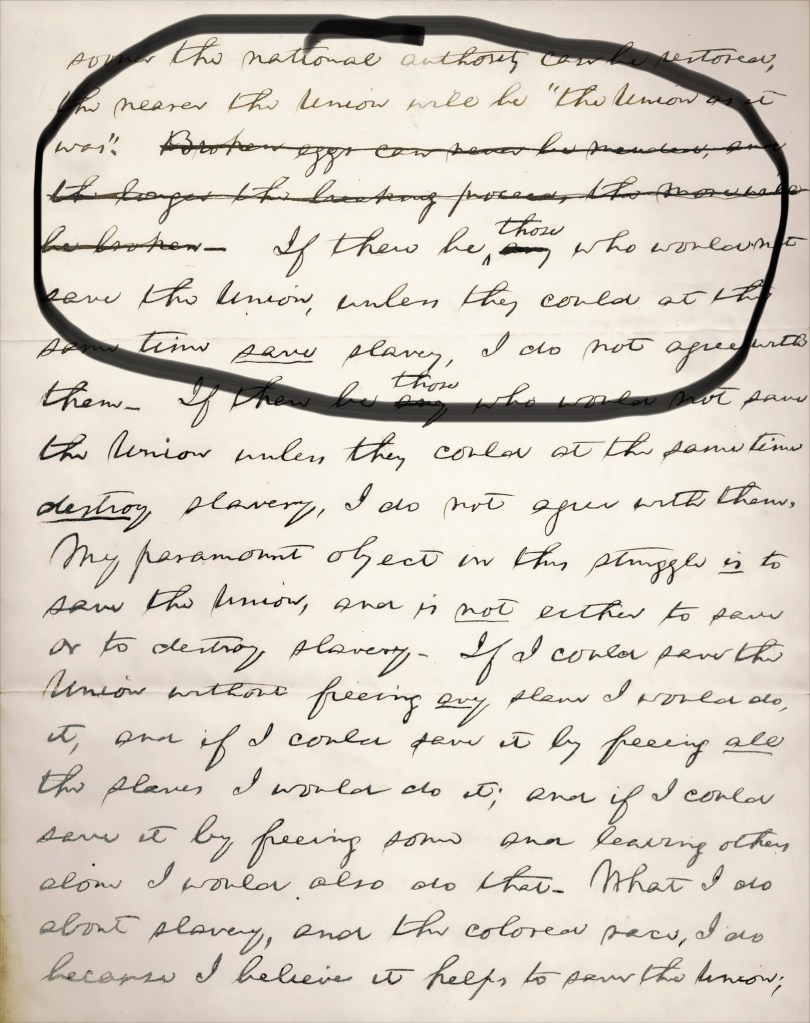
To see the original draft letter in Lincoln’s hand, with his underlined words for emphasis and the crossed-out sentence still visible, all of these revisions on the 3 page draft were omitted from the final text published publicly the next day in the newspaper.
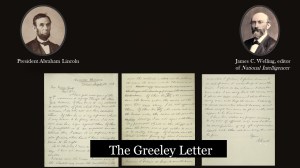
The original letter, written Friday, August 22, 1862 by Abraham Lincoln addressed to New York Tribune editor, Horace Greeley — but delivered and published by rival National Intelligencer editor, James Clarke Welling.
To see this letter – we are witnesses of the first draft — of history. Only viewed by few, yet I believe it is and always will be an American masterpiece. The editor, who is ultimately responsible for allowing us to view the Greeley Letter was my great- grandfather, James Clarke Welling.
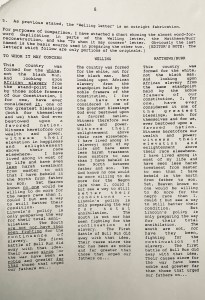
These are the last paragraphs from his 1880 article; Lincoln’s Emancipation Proclamation: its Origin, Motive, and Legal Effects
The Greeley Letter Aug 22, 1862 Touched the Spring that Moved the Dial of History
The Emancipation Proclamation did not draw its breath in the serene atmosphere of law. It was born in the smoke of battle, and its swaddling bands were rolled in blood. President Lincoln worked to save, they to destroy the Union.
These were fateful times, larger than any of the men who lived in them and the events then moving over the dial of history were grander than the statesmen or soldiers who touched the springs that made them move. JAMES CLARKE WELLING
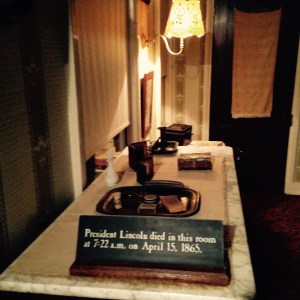
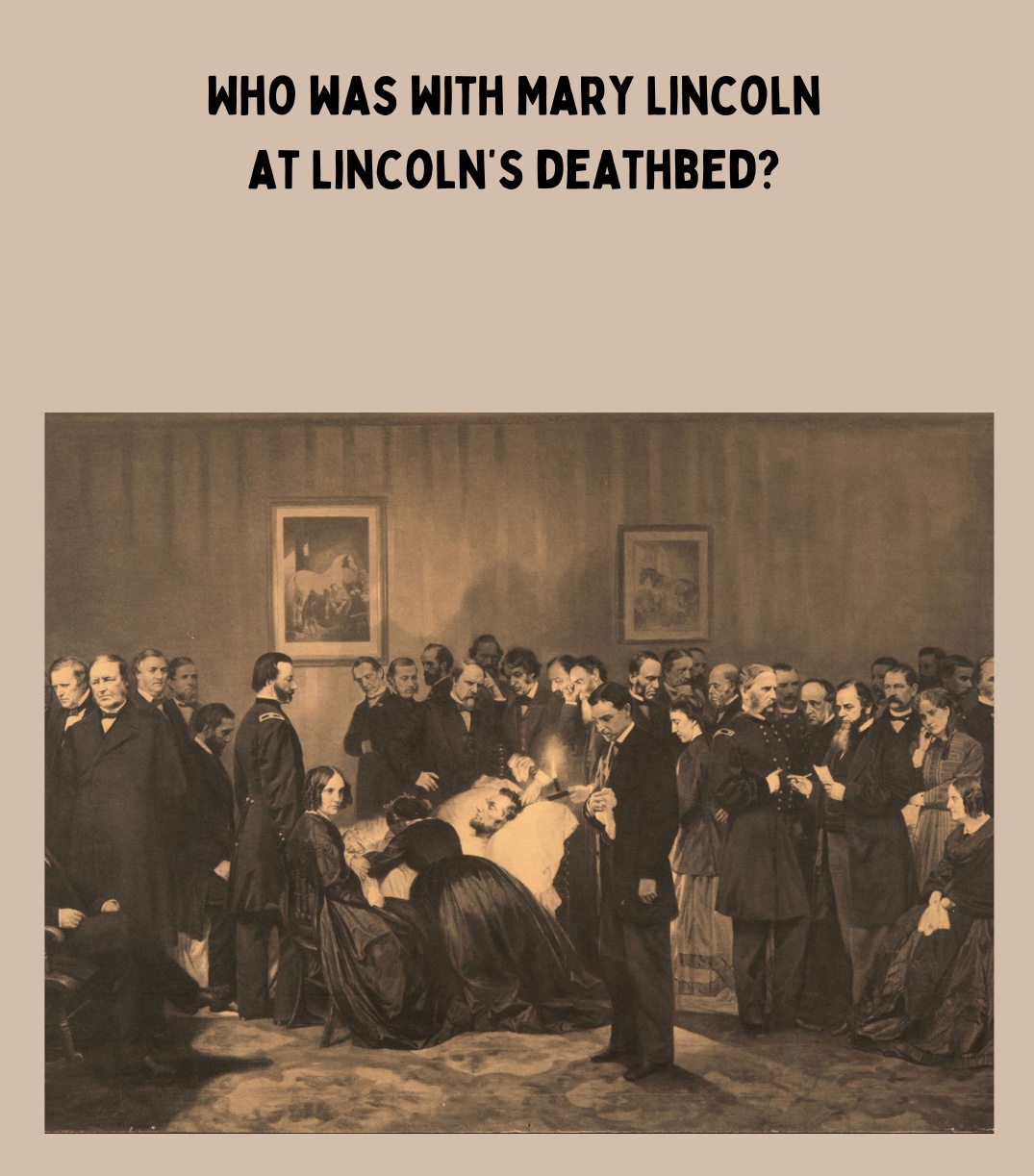
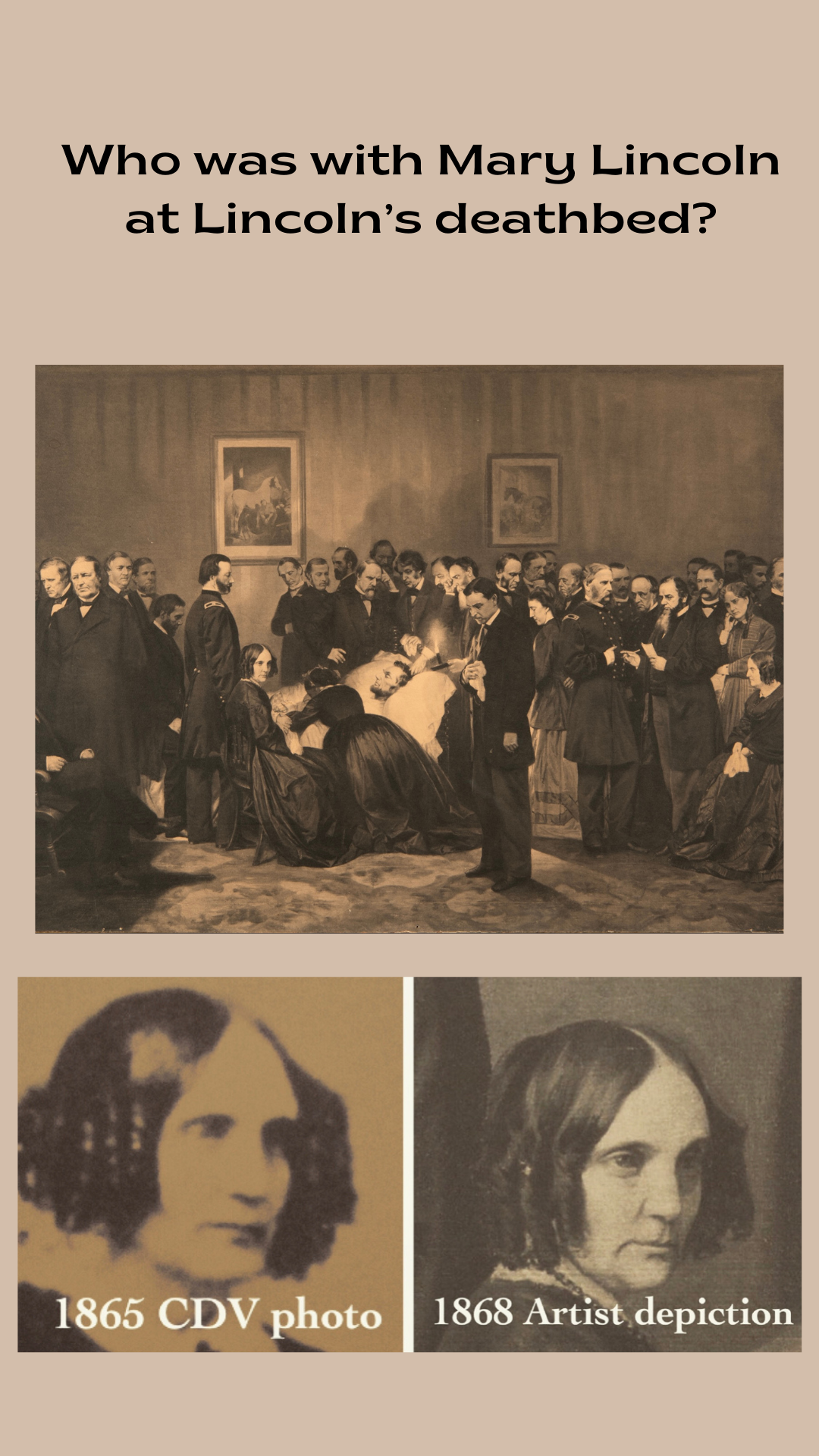
Every year on this day, I pause to remember the courage and kindness shown by my great-great grandmother on April 15th 1865. Summoned from her home on Lafayette Square, she was brought to the Petersen House across from Ford’s Theater to comfort her dear friend, Mary Lincoln, where she remained throughout the night and at 7:22am witnessed the death of President Abraham Lincoln.
It was the discovery of her lost diaries, letters and friendship keepsakes that retrace our family’s Civil War footprints and the Lincolns’ —from their first days in Washington until their last. Thank you, Elizabeth L. C. Dixon, for sharing your journey and a glimpse into the lives of the Lincolns from a new vantage point.
Video of my first visit to the Petersen House, April 15, 2005 8:00am, as Taylor Lane and I waited for our private tour given by Ford’s Theater NPS park ranger, Rae Emerson of the Petersen House, where our great-great grandmother had comforted her friend, Mary Lincoln throughout the night and present at 7:22am to witness the death of President Abraham Lincoln.
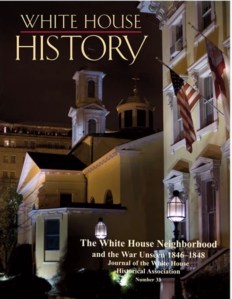
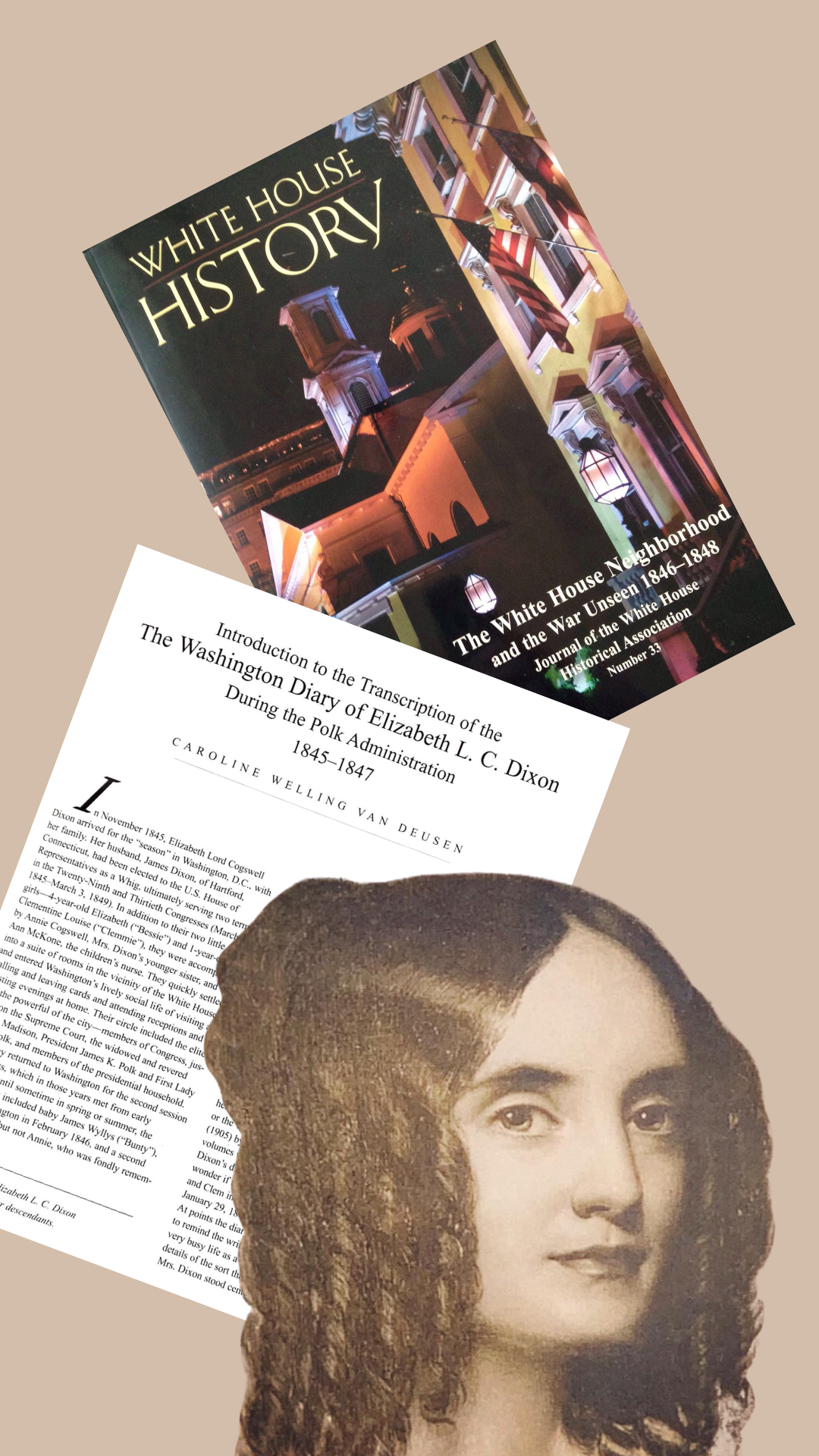
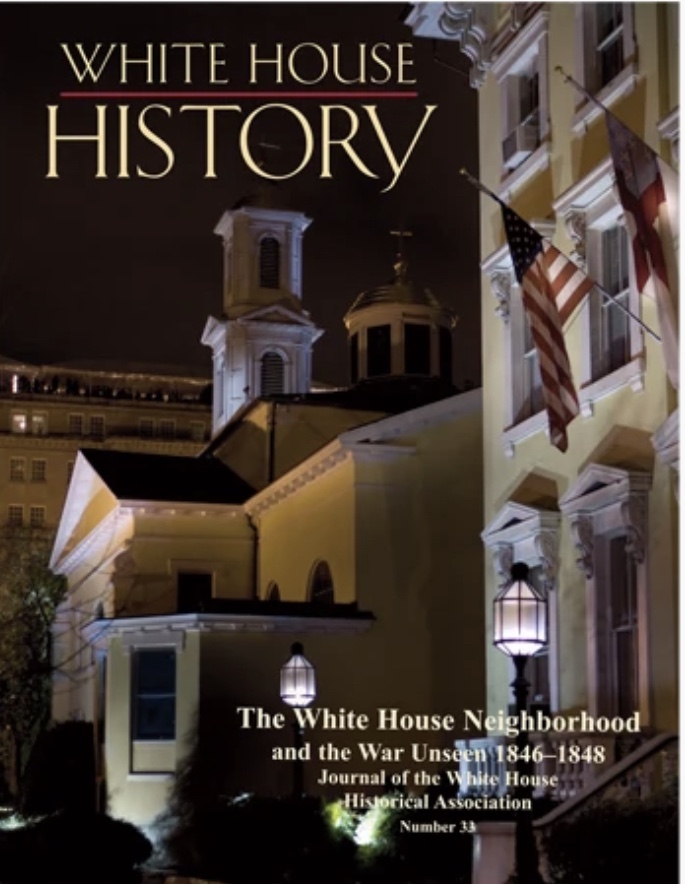
The Diary of Elizabeth Dixon, White House History, Issue 33
An excerpt from Diary of Elizabeth Dixon published in White House History, Issue 33, for Monday, December 15, 1845
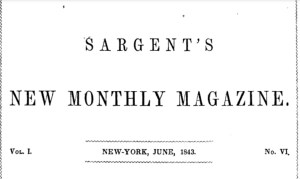
John O. Sargent spent the evening with us. Mr. Sargent is a brother of Epes who published my letter from Rome & the carnival in his magazine. 33.
Referring to the endnote for this entry —33: This account is “My First Day in Rome—Last Day of the Carnival” by a Lady of Hartford, signed E., Sargent’s New Monthly Magazine 1, no. 6 (June 1843), 251–53.
Sargent’s New Monthly Magazine
A quick online search uncovers * the short-lived magazine, Sargent’s New Monthly Magazine. In the June 1843 issue we confirm that Elizabeth Dixon had sent her account of her first day in Rome and last day of the Carnival to be published in Mr. Epes Sargent’s magazine. Only the editor and her close friends would know she had written the piece- instead she was “A Lady from Hartford”. This account of the 1841 Rome Carnival, taken from pages of her European honeymoon travel diary is the only known writing Elizabeth Dixon published during her lifetime.
“My First Day in Rome—Last Day of the Carnival” by a Lady of Hartford
We had hastened from Pisa to Rome, to be in season for the last days of the Carnival, when the revelry is at its height. There is nothing very interesting in the route, excepting the beautiful city of Sienna, with its cathedral of black and white marble, the floor of mosaic representing the life of David. The Italian language is here spoken in its greatest purity. The country is not remarkable for beauty, and the principal stopping place between Sienna and Rome, is situated on the top of an extinct volcano, whose sides are bare and brown.
The roads are perfect, and we were whirled along with such rapidity, that on the third morning after we left Pisa, our eyes rested on the campagna of Rome.
This is a tract of uncultivated land extending for miles around the city, and uninhabited, save by a few poor shepherds, who may be seen here and there, in their picturesque sheepskin cloaks and slouched hats, with crook in hand, watching their flocks. They have a cadaverous appearance, for the campagna is infected with malaria, and may be called “the abomination of desolation.” Grass grows, and a kind of dwarf tree or shrub, but there is nothing like vigorous and healthy vegetation. There are some slight fences, probably lines of demarcation, and occasionally we passed an old tomb, a broken and ruined wall, but nothing that looked like a habitation for a human being for many miles.
The day was the 22d of February, the air was soft and warm, the green lizard was gliding about in the grass, or sunning itself on the fragments of ruins.
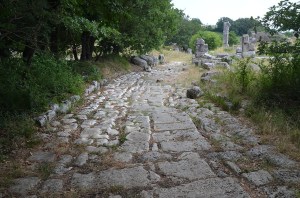
At last, we saw St. Peters, like a mountain against the clear blue sky, entered the Via Flaminia, and crossed the yellow Tiber. We had given our fancy flight through the past, and our minds were filled with the grandeur of the Caesars, when we were brought down to Modern Rome, entered the gates, and were stopped at the Custom-house, the commonplace of all travelers.
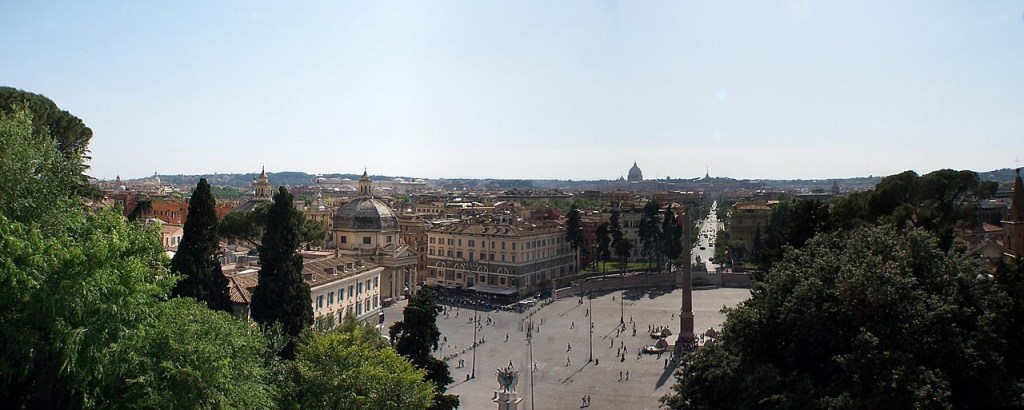
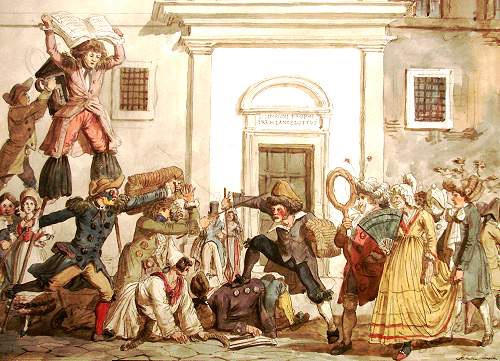
There is no more favorable view of the streets of Rome than from this entrance. The Piazza del Popolo with its great Egyptian obelisk, and fountains are before you; and beyond, the Corso, the finest street in Rome, extends as far as the eye can reach. On the left is the Pincian Hill, “terrace upon terrace, and rich in statues, cypresses and fountains;” next to it are the Hotels d’Europe and de Russie, built on the sites of ancient palaces, and palaces themselves, with their beautiful gardens. As we entered the city and drove to the Hotel de Russie, the Pincian Hill was covered with soldiers, marching down the terraces line after line, with helmets and bayonets gleaming in the sun, and troops of cavalry in gay uniforms and equipments, with their prancing horses. Martial music filled the air, and it seemed as if the old Caesars were yet alive, and we had come to witness a Roman triumph. The windows of the hotel were all open, the gardens filled with roses and violets which perfumed the air around, the delicious oranges and lemons hung in their dark rich foliage, birds were singing, and it seemed like the golden age of the world. We amused ourselves during the remainder of the day in looking out of the windows upon the novel sights, laughing at the dresses of the masquers, and occasionally receiving a bouquet or a present of sugar – plums, in the face, from some passing Punchinello, or it might be a greater character. In the evening some of our party attended a masquerade at the Apollo Theatre, but we reserved ourselves for the last great day of the festival.
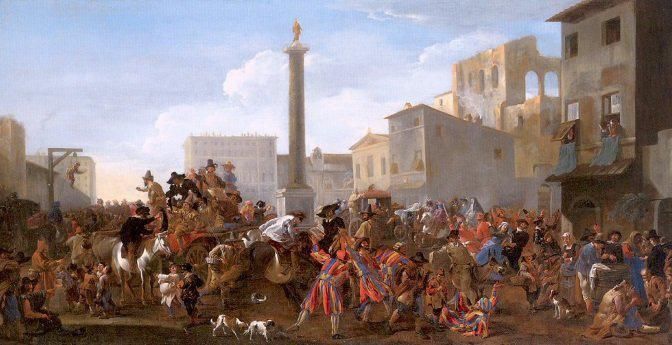
The old adage “When you are in Rome you must do as the Romans do,” was on this occasion followed by us to the letter, and in the spirit too. Ours was one among the crowd of carriages, which followed each other in close file, up one street, and down another, from nine in the morning until after dark. Most of their occupants were masked or held before their faces small wire screens like sieves, to keep off the volleys of sugarplums.
Thousands of people on foot were dressed in as many odd costumes, according to their fancies, and were throwing bouquets and sugar – plume, or selling them to those in the carriages. Every one seemed perfectly gay and happy, and decidedly good – natured, for if a perfect tempest of bonbons were poured on one, the only way was to shake them off with a laugh and return the compliment. Indeed, our carriage was so full of voluntary contributions that we had to wade through them from one side to the other, and our path was literally “filled with flowers.” There were several steamboats on wheels (for the equipages were as odd as the inmates,) and when one of these was opposite, so slowly did they move, the pelting from all “the hands” was “pitiless” and quite overpowering. Before we started, we thought it must be great folly and become very tedious to spend a day in this manner, but we had not been through one street, before we found it was the most exciting amusement in the world, about as rational as any battle, and as some wiseacre remarked, “far less injurious.”
This sugar and floral warfare lasted till four o’clock in the afternoon, when a gun was fired to announce the commencement of the races.
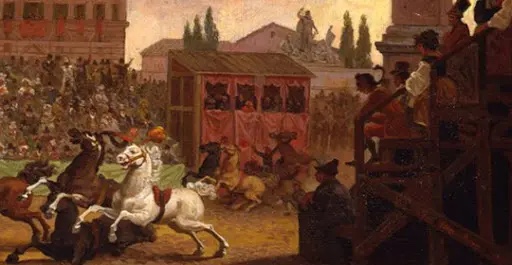
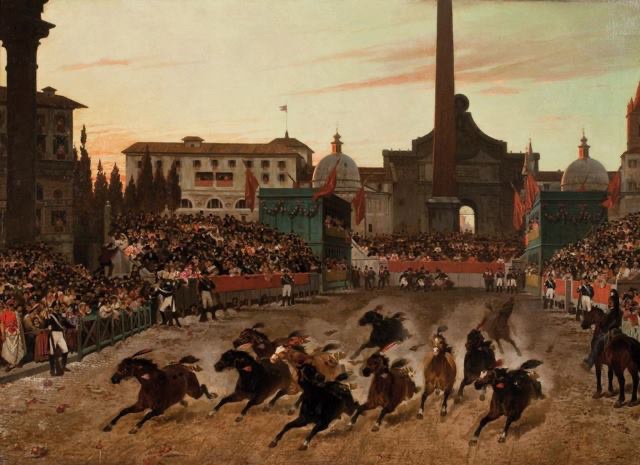
Our carriage fortunately drew up in the Piazza del Popolo, where the horses were to start. Around the obelisk, seats in the form of an amphitheater had been erected, which, as well as the streets, were densely crowded.
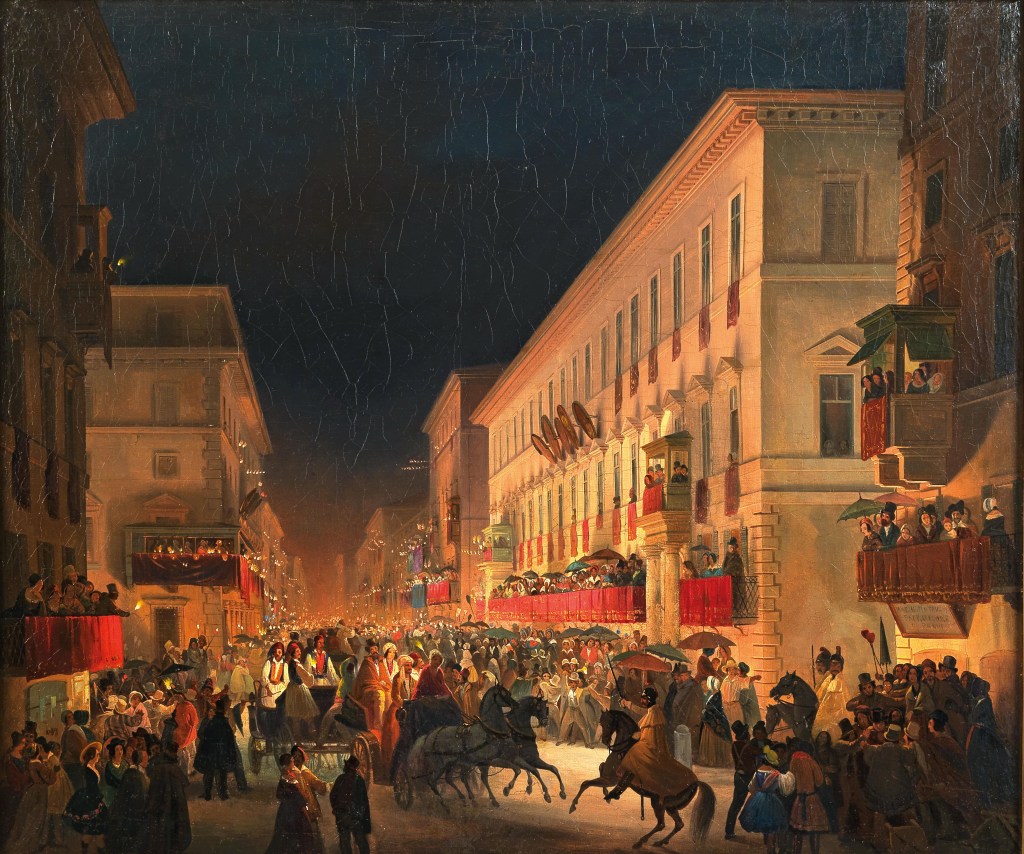
The houses through out the Corso were hung with drapery of scarlet, orange, green, and other bright colors, waving gayly in the breeze; the roofs, windows, and balconies were filled with heads, music was playing, and the shouting and buzzing of the crowd made the whole scene perfectly bewildering.
A second cannon was fired, and a phalanx of soldiers marched through the street, followed by a troop of horse, to clear the way for the principal actors in this scene.
A third cannon -and that great crowd were hushed into silent and almost breathless expectation.
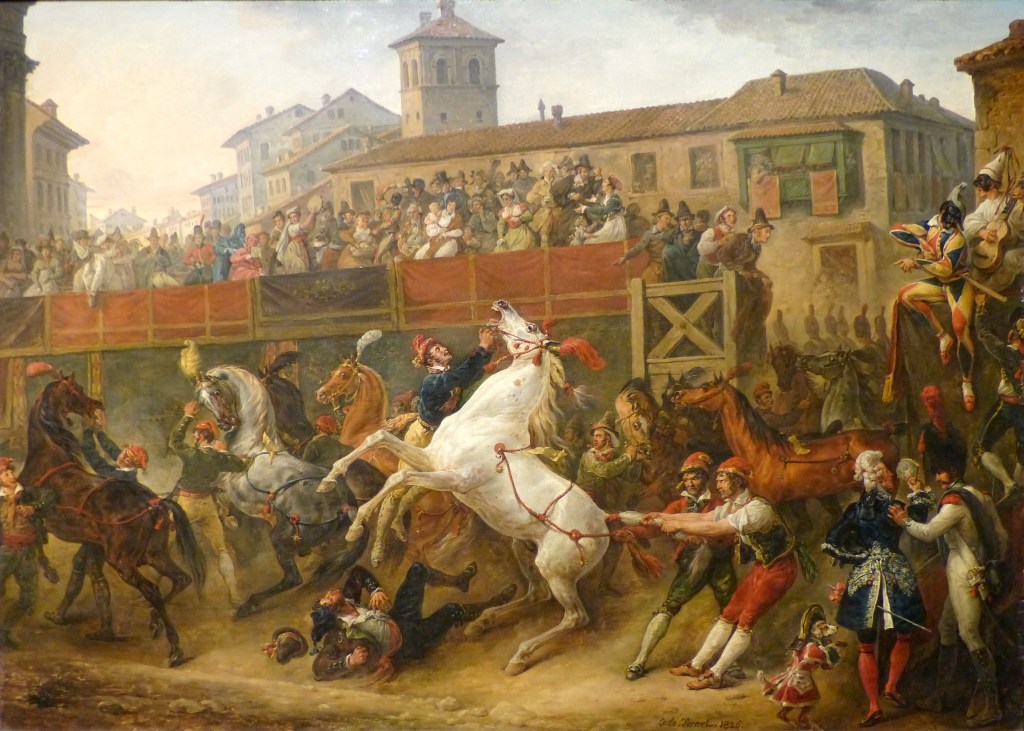
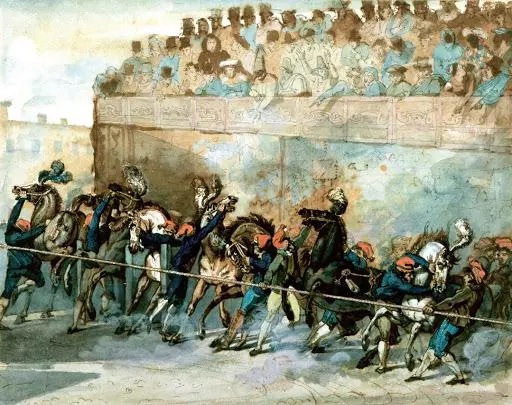
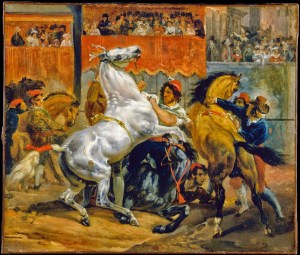
Twelve small horses were led out to a barrier at the head of the street. They were so impatient that it was almost impossible to hold them; they seemed “to smell the battle, the thunder of the captains, and the shouting.”
They were decorated with cloth of gold, feathers, and ribbons, according to the taste of their masters. In a few moments a trumpet sounded, and, like winged creatures, they were in an instant out of sight.
The animals exhibited frightful impatience if checked or impeded in their way by the crowd, and woe to the unfortunate man, woman, or child who was the cause! A beautiful flag or other trophy was placed upon the head of the victor.
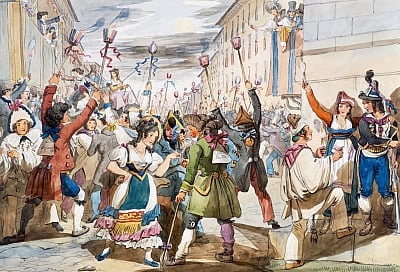
After the race, men came through the streets, selling small wax tapers and poles with fixtures for them, and it was every one’s duty to supply himself, and light them at dusk. Then what a curious scene there was! Every one trying to extinguish his neighbor’s light. It was as if the stars had come down and gone to fighting. This continued two hours and more, until the last Polyphemus had his eye put out, and then the crowd dispersed, to prepare for the masquerade later in the evening.
We went to Torlonia Theatre, which is very elegant and spacious. There are six tiers of boxes, and on this occasion the pit was covered with a floor for dancing. It was amusing enough to mingle with the crowd, and see the odd figures and costumes, nearer than in the daytime, and often to be accosted in one’s own tongue, by some being who looked as if he came from Pandemonium, perhaps in a scarlet dress hung all over with little bells, and great horns on his head, who would ask the most familiar questions about your affairs – and then to go up to the highest tier of boxes, and look down upon this motley assembly, which beggars all description, except as the oddest, funniest, and queerest of all scenes.
The night before, there was a tragedy as well as comedy. An Italian and his lady were accosted by an Englishman, who thought the lady was an acquaintance, and, after an unsatisfactory questioning and cross questioning, he ventured to raise the lady’s mask, but in so doing received a stab from her husband. The wound proved mortal, the Italian was thrown into prison, but it was decided to be a breach of law to raise a lady’s mask or veil, and he was liberated. Who shall say that the days of chivalry are past? The murder, for we can call it nothing else, occasioned a little commotion among the bystanders, but the crowd passed on, and all was forgotten.
Twelve o’clock arrives; and the whole carnival is ended. Religion takes the place of folly; and harlequin dresses are exchanged for sackcloth and ashes. E.
——————- This post shared new details about the life and writings of Elizabeth L. C. Dixon. My transcription of her 1845-1847 Washington diary was published in White House History, Issue 33, by the White House Historical Association. Below is a link to transcription:
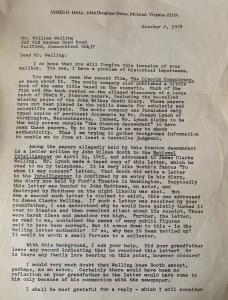
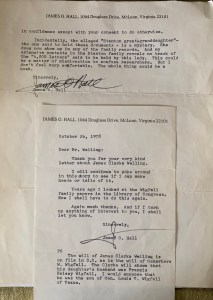
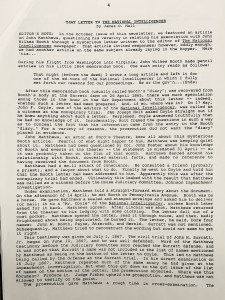
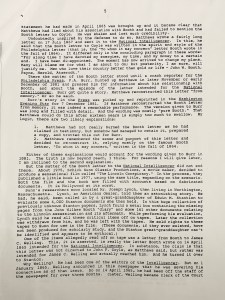
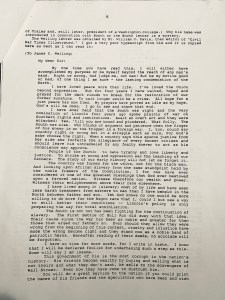
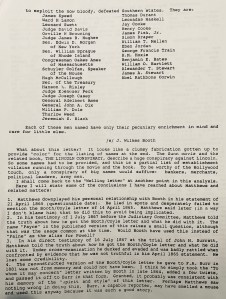
In 2000, right around the time I discovered the Alonzo Chappel painting that confirmed Elizabeth Dixon’s friendship with Mary Lincoln, I found this letter sent to my father in 1978 from James O. Hall.
Hall’s inquiry took me down rabbit hole but am glad I was able to connect with Dr. Hall shortly before he died. This letter was written two years after the film, Lincoln Conspiracy was released.
James O. Hall letter page 1
James O. Hall letter page 2 and note
Notes:
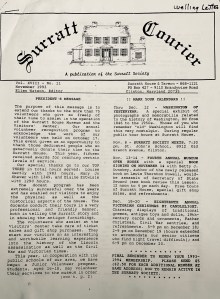
May 15, 2000, I spoke by phone with James O. Hall, who was, as it turned out, the authoritative expert on the Lincoln assassination. He suggested I go to the Washingtonia Room at the Martin Luther King Library to find the National Intelligencer papers or the Library of Congress Reading Room. Also, see Michael Musick at the National Archives regarding WW Corcoran’s clandestine trip to Europe in 1865. He wondered if James C. Welling was mentioned. Locations etc. He said check Civil War Times editorials regarding Neff fabrication. Jack Davis, William C. Davis is the editor that collaborated with him on articles and research. Hall had a friend named Alan Weber who has the Chappel file, about to sell for big $$$. He said Neff’s fabrication, “Lincoln Conspiracy”, he was a professor at Indiana, and had a falling out and is now a private detective. Hall said; “He is a good liar.” He sent an article he wrote for the 1993 Surratt Courier, as a follow up. It was very interesting.
At the end of our conversation I asked James O. Hall; “What do you think James Clarke Welling would have done if he was given Booth’s letter?”
He replied; “I think he was a good journalist and would have given it to Stanton.”
Over the last 20 years, I have thought back on our talk and continue to wonder, why would someone like Neff and Lynch intentionally lead people to believe in a hoax? “6,000 letters?” Who has such a collection and why the secrecy? No answers today, tomorrow or perhaps never. Just makes me wonder…
In the evening of April 15, 2021, the 156th anniversary of the death of President Abraham Lincoln the Arts Club of Washington commemorated his life and legacy with the virtual program, “Lincoln’s Last Breath”.
The program explored Civil War friendship of Mrs. Elizabeth L. C. Dixon, wife of Senator James Dixon of Connecticut and Mrs. Mary Todd Lincoln.
Elizabeth Dixon, was my great great grandmother, and she left us a trove of letters and relics that allow us to retrace her foot prints and friendship with the Lincoln‘s from their first days in Washington until their last.
Elizabeth and her junior congressman husband, James Dixon of Connecticut had first come to Washington in November 1845, during the Polk administration. During these years she kept a journal, a diary, that described those first years in Washington. It had been partially transcribed in the 1970s by my great aunt Elsa, before she donated it to the Connecticut Historical Society, where it remained virtually forgotten.
Elizabeth Dixon was my grandfather’s grandmother. She was my great, great grandmother. This diary, she had dedicated to her daughters Bessie and Clementine. Clementine awas my great grandmother, Mrs. Clementine L.D. Welling.
Journal written during a residence in Washington during the 29th Congress commencing first of Dec, 1845 Dedicated to my daughters Bessie in Clementine by their mother, Elizabeth L. C. Dixon
From 2009-2012 I took on the arduous task and transcribed her 50 page handwritten diary and submitted this transcription to the White House Historical Association, who published; The Diary of Elizabeth Dixon in
During Covid, I have been transcribing another of Elizabeth Dixon‘s diary, the Dixon’s 1840-41 Honeymoon Grand Tour through Europe. Watch for future posts. Until then, Caroline
David J. Kent recently wrote a post on Lincoln Group of District of Columbia’s new website about my family’s connection with the Lincolns. Here is a link to his concise and kind words about the Dixon and Welling family association and friendship with the Lincolns. Also below is his post in its entirety. Thank you David Kent!
Lincoln Group Member Traces Pedigree to Greeley Letter
By David J. Kent, Washington D.C.
Abraham Lincoln’s response to Horace Greeley’s “The Prayer of Twenty Millions” editorial contains perhaps one of the most recognized—and misrepresented—passages in history. Long-time Lincoln Group of DC member Caroline Welling Van Deusen’s great-grandfather was instrumental in its publication. Caroline says she is not a historian but has taken on the role of family archivist for her ancestors. And what ancestry she has! One great-great-grandmother, a “close friend of the Lincolns, witnessed Lincoln’s death.” She was Elizabeth Dixon, who after being summoned by Robert Lincoln the night of April 14, 1865, stood vigil with Mrs. Lincoln at the Petersen House as her husband faded away in the next room.
Even closer was Caroline’s great-grandfather, Dr. James Clarke Welling, editor of the National Intelligencer. The story begins on August 20, 1862 when Horace Greeley, Republican Party leader and editor of the New York Tribune, published his editorial. Greeley’s public letter called for Lincoln to immediately declare emancipation for all enslaved people in Union-held territory. Not to be outdone, Lincoln saw the opportunity to present his position on emancipation, knowing his completed Emancipation Proclamation was sitting in his desk waiting for a military victory to announce it. Rather than send the letter to Greeley, Lincoln sent his response to Welling’s Intelligencer for publication two days later.
Hon. Horace Greeley:
Dear Sir.
I have just read yours of the 19th. addressed to myself through the New-York Tribune. If there be in it any statements, or assumptions of fact, which I may know to be erroneous, I do not, now and here, controvert them. If there be in it any inferences which I may believe to be falsely drawn, I do not now and here, argue against them. If there be perceptable in it an impatient and dictatorial tone, I waive it in deference to an old friend, whose heart I have always supposed to be right.
As to the policy I “seem to be pursuing” as you say, I have not meant to leave any one in doubt.
I would save the Union. I would save it the shortest way under the Constitution. The sooner the national authority can be restored; the nearer the Union will be “the Union as it was.” If there be those who would not save the Union, unless they could at the same time save slavery, I do not agree with them. If there be those who would not save the Union unless they could at the same time destroy slavery, I do not agree with them. My paramount object in this struggle is to save the Union, and is not either to save or to destroy slavery. If I could save the Union without freeing any slave I would do it, and if I could save it by freeing all the slaves I would do it; and if I could save it by freeing some and leaving others alone I would also do that. What I do about slavery, and the colored race, I do because I believe it helps to save the Union; and what I forbear, I forbear because I do not believe it would help to save the Union. I shall do less whenever I shall believe what I am doing hurts the cause, and I shall do more whenever I shall believe doing more will help the cause. I shall try to correct errors when shown to be errors; and I shall adopt new views so fast as they shall appear to be true views.
I have here stated my purpose according to my view of official duty; and I intend no modification of my oft-expressed personal wish that all men every where could be free.
Yours,A. Lincoln.
Lincoln’s letter didn’t go untouched. John Nicolay notes the audacity of James Welling when the young editor requested a last-minute modification. Welling “wanted to make a change to the text so…suggested its omission,” says Nicolay. “President Lincoln good-naturedly complied.”
For Caroline, researching her family history and the Greeley letter in particular has become a family passion in memory of her great-grandfather and “to honor the contributions made during his lifetime to journalism, education, and community.” She recently finished a project that honors both her great-grandfather James Welling and Lincoln. More information on the project can be found at https://thegreeleyletter.com/.
Reflecting on Lincoln’s understanding of the importance of “public sentiment,” Caroline notes that “public sentiment was what Lincoln was interested in when he wrote his famous letter to Horace Greeley…wasn’t it?” Indeed, it was. Lincoln was preparing the nation for his Emancipation Proclamation that would free some of the enslaved, as he alluded in his letter, but only in those states in rebellion where he believed he had the authority under constitutional war powers to take action.
And for Lincoln Group member Caroline Welling Van Deusen, she can thank her ancestors for playing such a huge role in Lincoln history.————————————-
Of the millions of pages of history written about the Civil War, my focus lately has been a three page letter written in Lincoln’s handwriting. It is the famous letter President Lincoln wrote on August 22, 1862 to Horace Greeley, editor of the New-York Tribune. Words from this letter are etched in history:
My paramount object in this struggle is to save the Union and is not either to save or to destroy slavery.
Lincoln historian, Phillip Shaw Paludan wrote in The Presidency of Abraham Lincoln:
If there is one document that is more often quoted than any other in the argument, debate, or conversation about Lincoln — it is the letter that Lincoln wrote on August 22, 1862 to Horace Greeley.
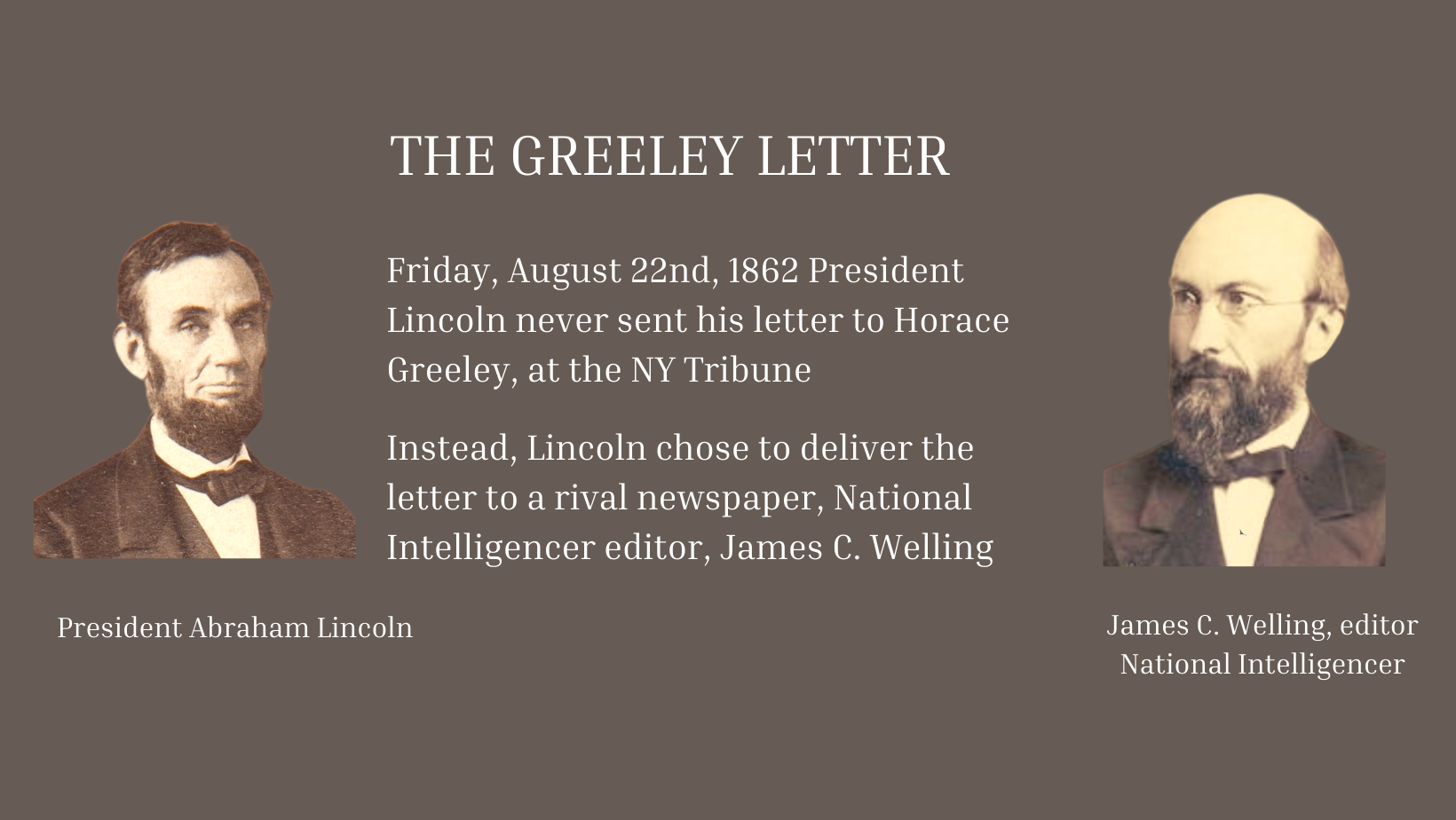
It was on Friday, August 22nd, 1862 President Abraham Lincoln finished writing his now famous letter to Horace Greeley, editor of the New-York Tribune.
President Lincoln decided not to send the letter to Greeley. Instead, he had the letter delivered to James C. Welling, editor of the National Intelligencer, a rival newspaper to publish the following day.
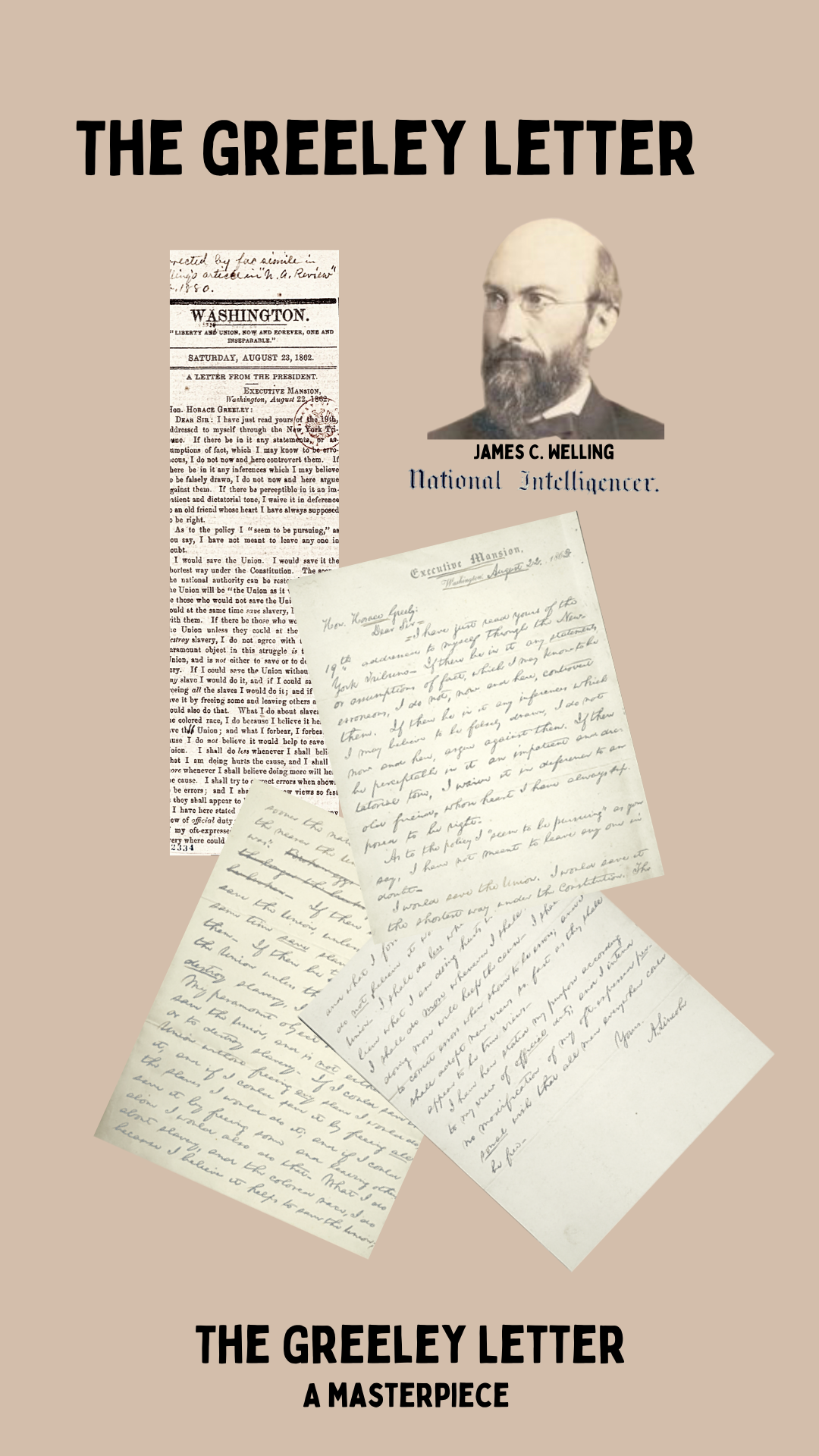
Looking at the original letter, you see that one sentence has a line through it, as though Lincoln changed his mind and crossed the words out.
The Greeley Letter, page 2 of 3, revision approved by Lincoln, requested by James C. Welling, editor, National Intelligencer John Nicolay recalled James C. Welling asked Lincoln to revise the Greeley letter
President Lincoln’s secretary, John Nicolay shared the backstory about this revision in Princeton College Bulletin, 1895:
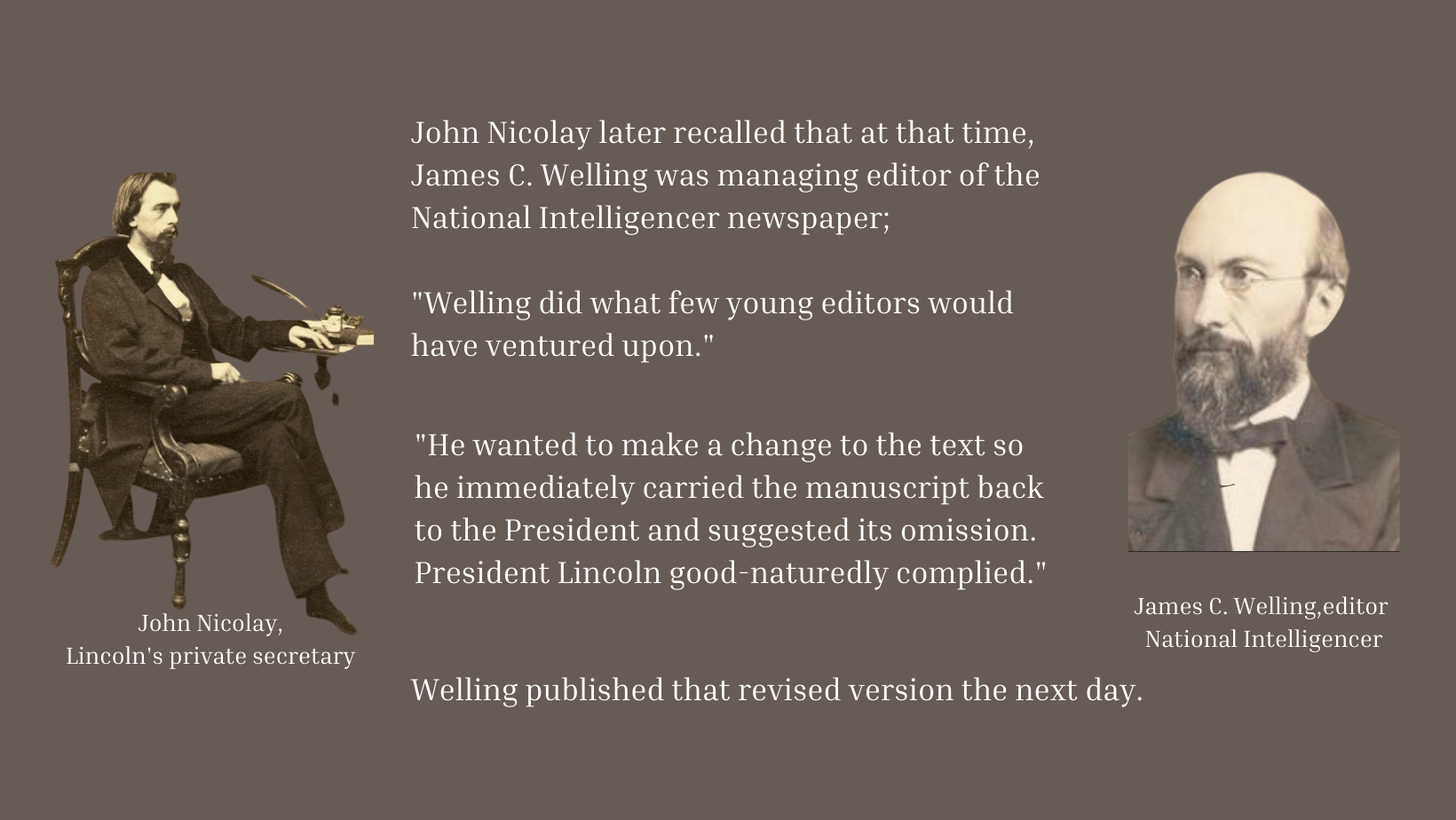
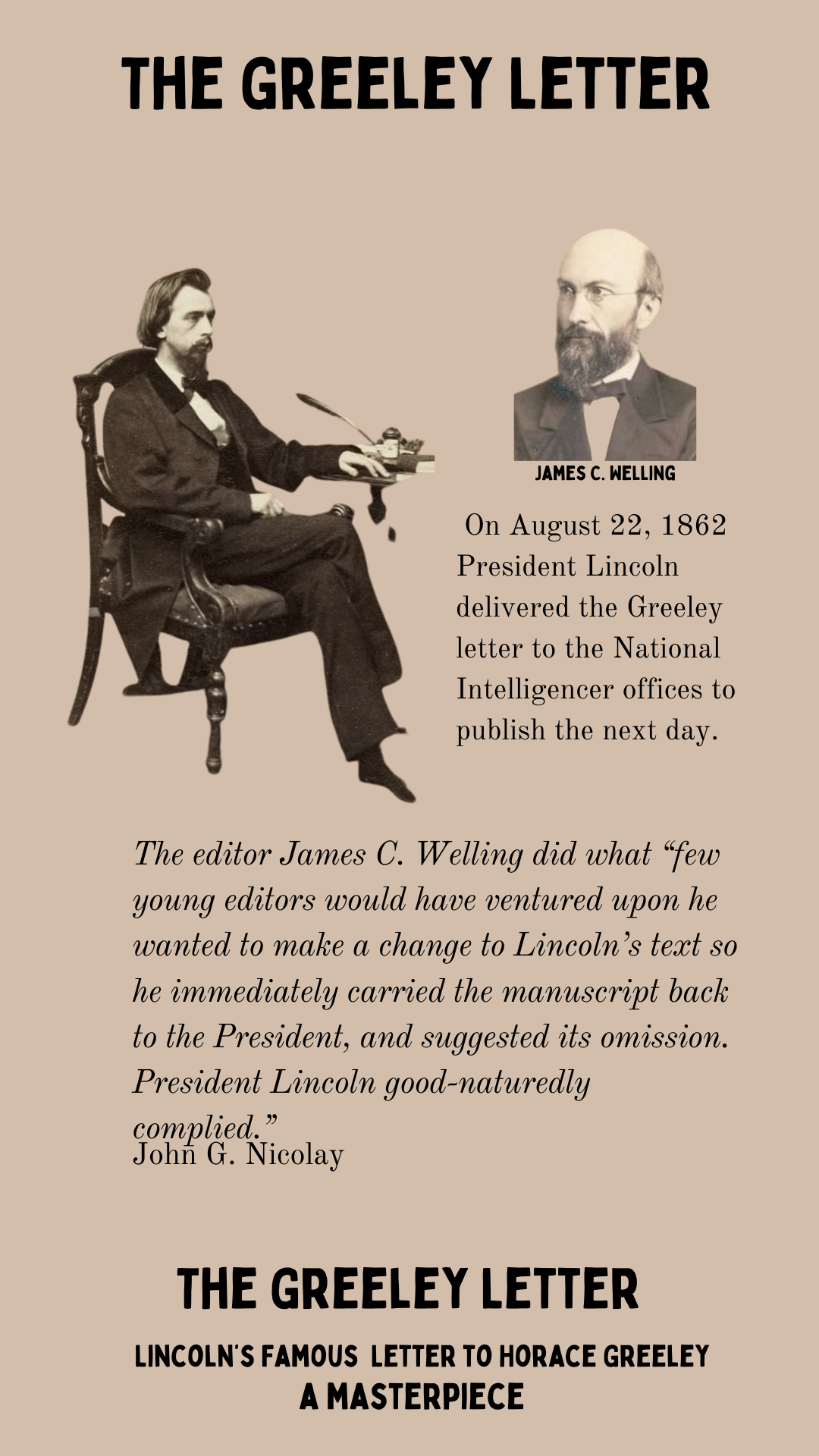
On August 22, 1862, the associate editor of the National Intelligencer, James Clarke Welling did what few young editors would have ventured upon.
He wanted to make a change to Lincoln’s text so he immediately carried the manuscript back to the President and suggested its omission. President Lincoln good-naturedly complied.
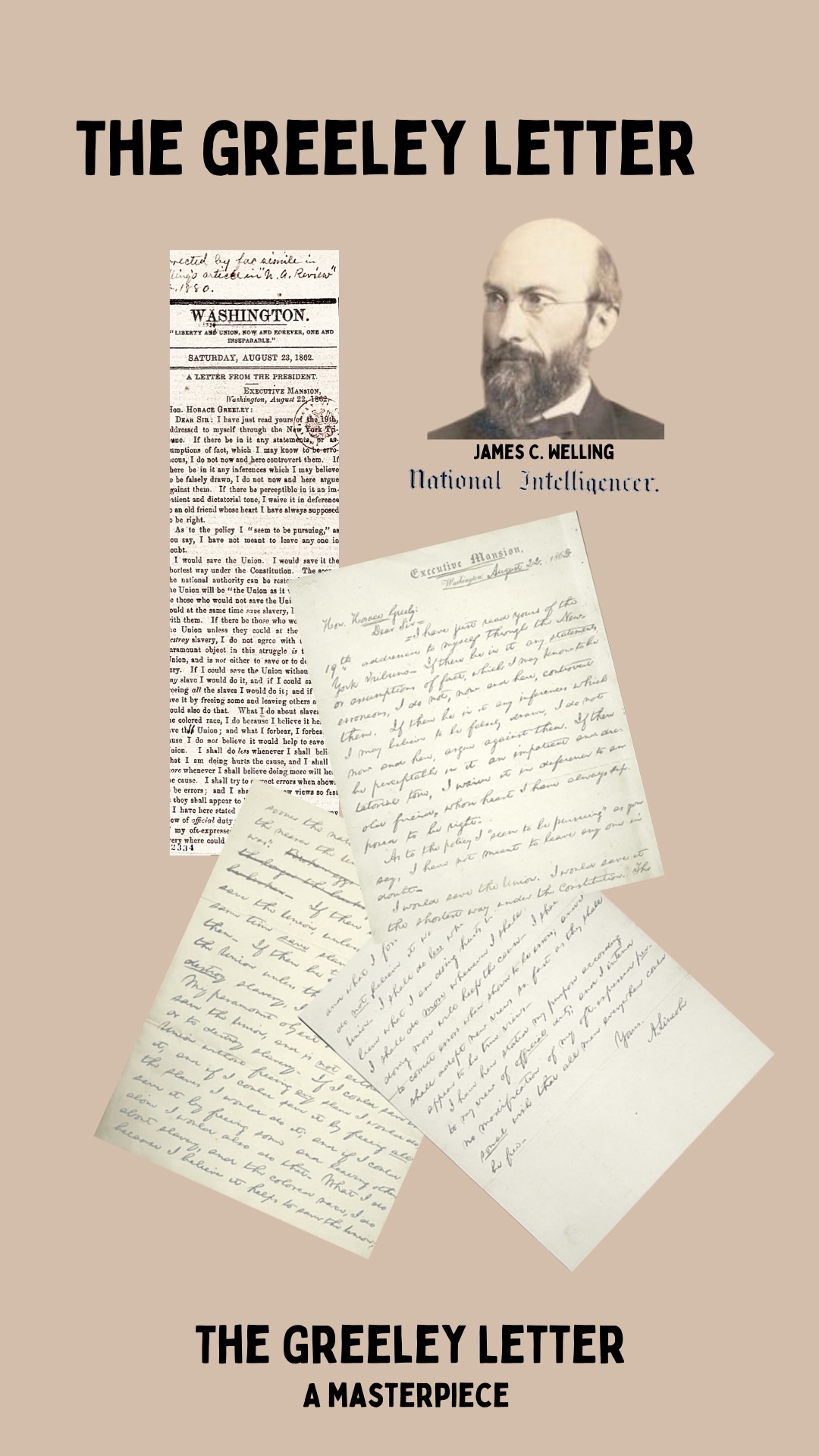
The original letter written by Lincoln, yet revised and published by Welling is a masterpiece.
On Saturday August 23, 1862, Horace Greeley read the famous Greeley Letter, a reply to his editorial, Prayer of Twenty Millions, in a letter addressed to him from President Lincoln within the pages of another newspaper, the National Intelligencer.
The Greeley Letter, I believe, is a masterpiece – an American history treasure. It is inspiring beyond words, three quintessential pages of history.
I’m not alone. My great grandfather, James C. Welling, to whom Lincoln gave the letter, certainly believed it was an American treasure. He kept the Greeley letter his entire life.
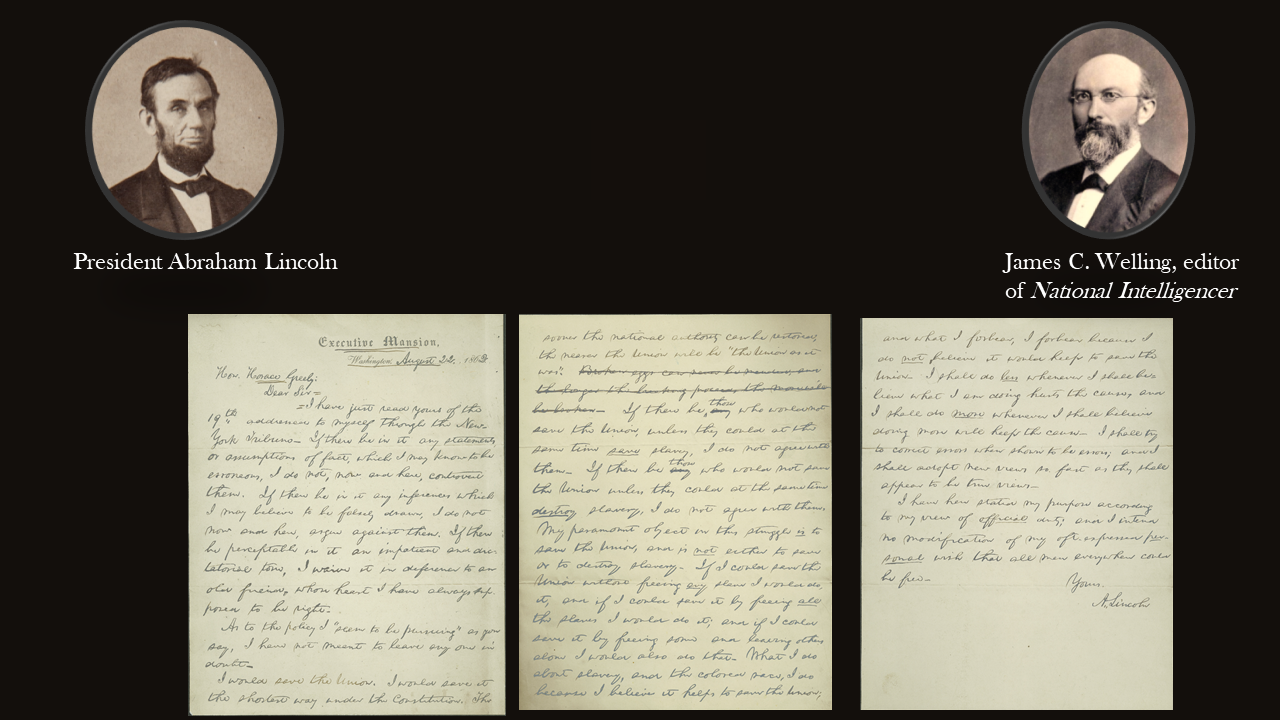
Lincoln and James C. Welling above Lincoln’s letter to Horace Greeley given to Welling.
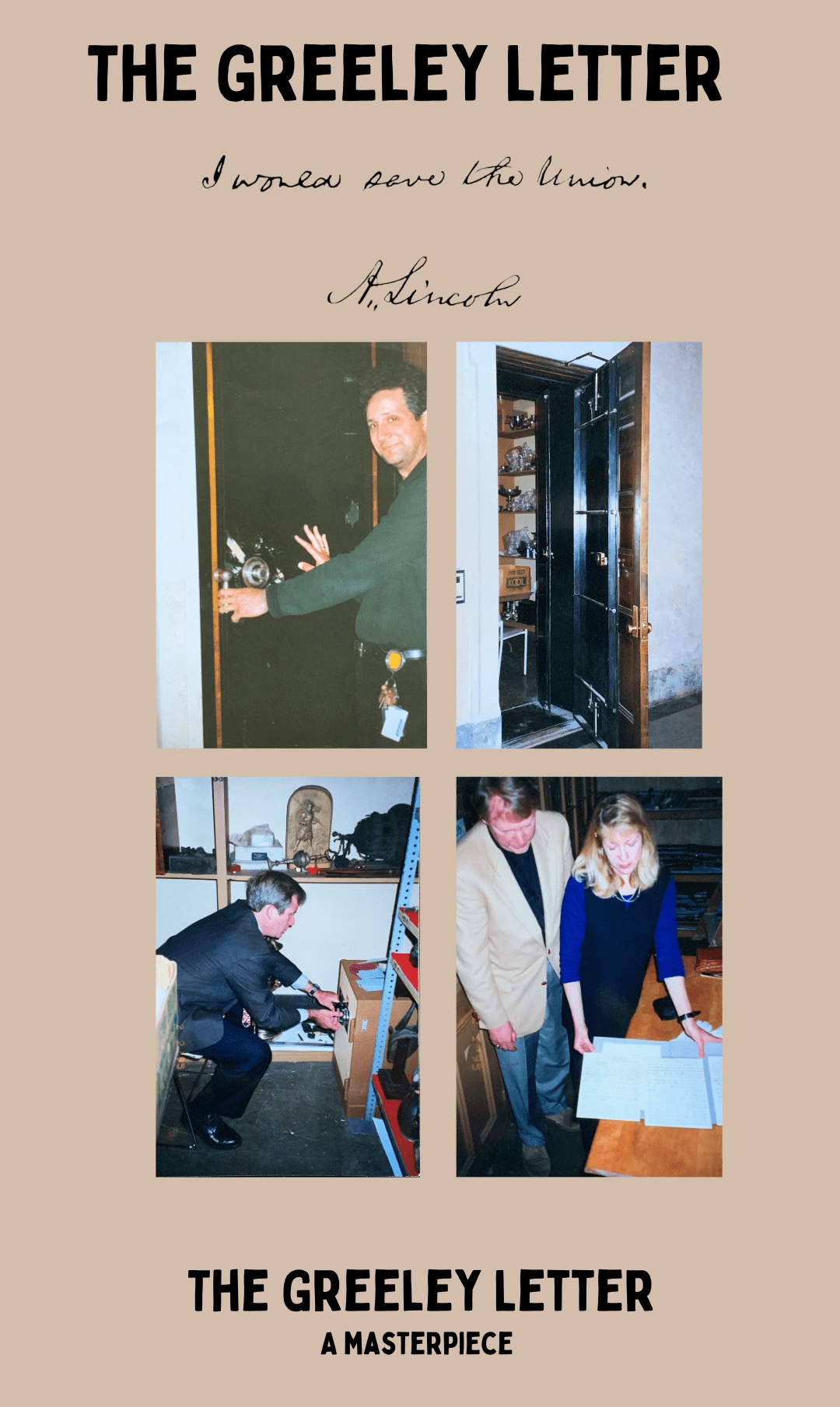
And after his death our family fulfilled his wishes to find a permanent home for the famous Greeley Letter. We chose not to sell it to a private collector but place the masterpiece where the greatest number of people would see it, and accessible to the public, in perpetuity. What better place for the Greeley Letter, our masterpiece, than the oldest public art museum in the country, the Wadsworth Atheneum.
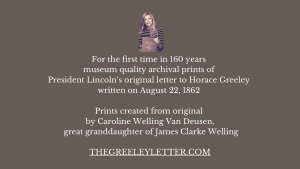
Knowing the Greeley Letter is safely preserved, within a safe, in a vault at the Wadsworth Athenaeum, I continue with our family’s wish—- that the greatest number of people could see the masterpiece, so that’s why I began an initiative during the Covid pandemic to create Archival Prints of the famous Greeley Letter.
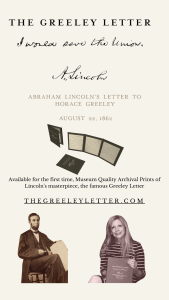
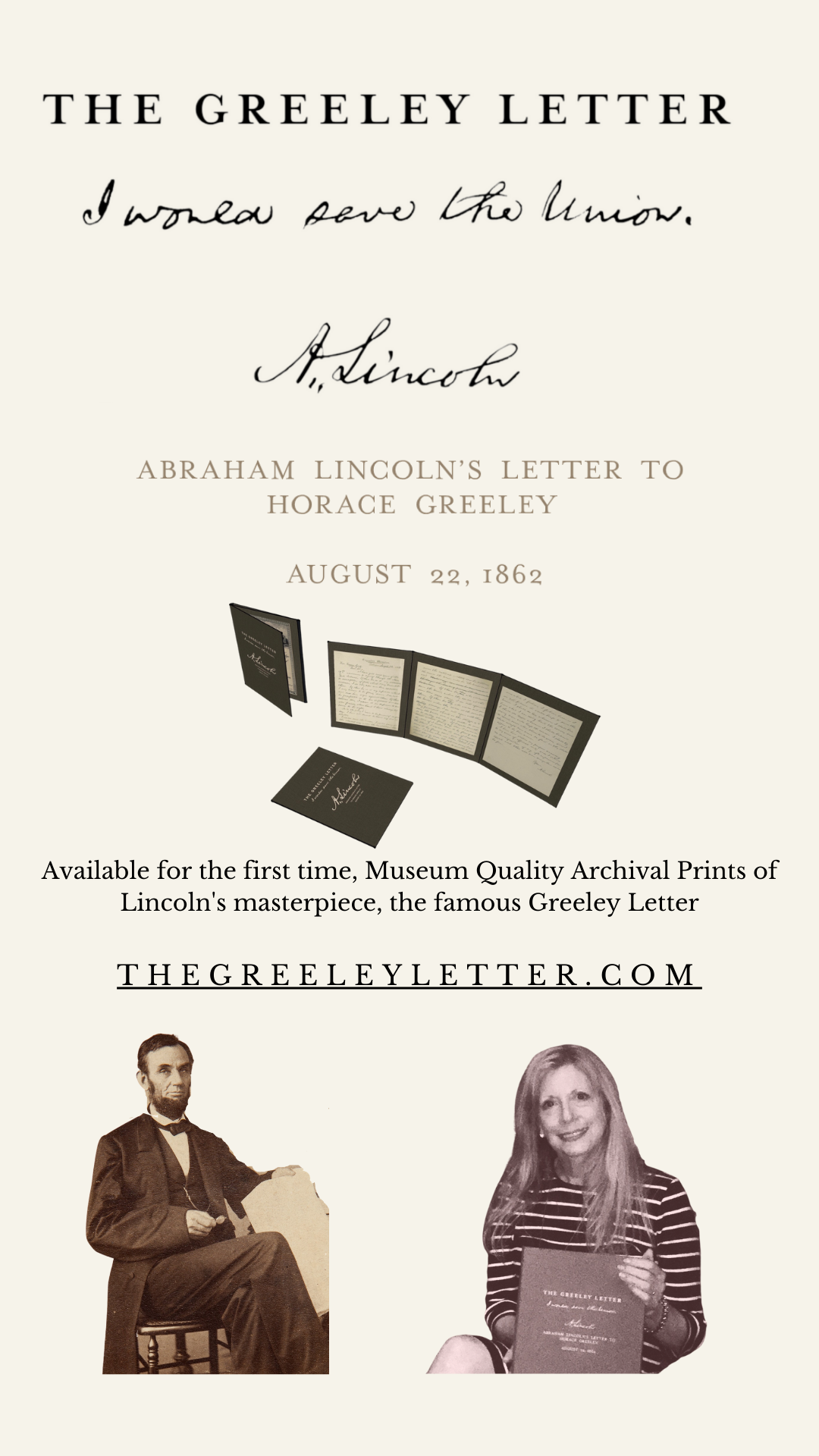
Today, I am proud to announce my 2021 launch of my website: TheGreeleyLetter.com and a limited series of archival prints for sale. I personally printed, packaged and will ship Greeley Letter prints to you.
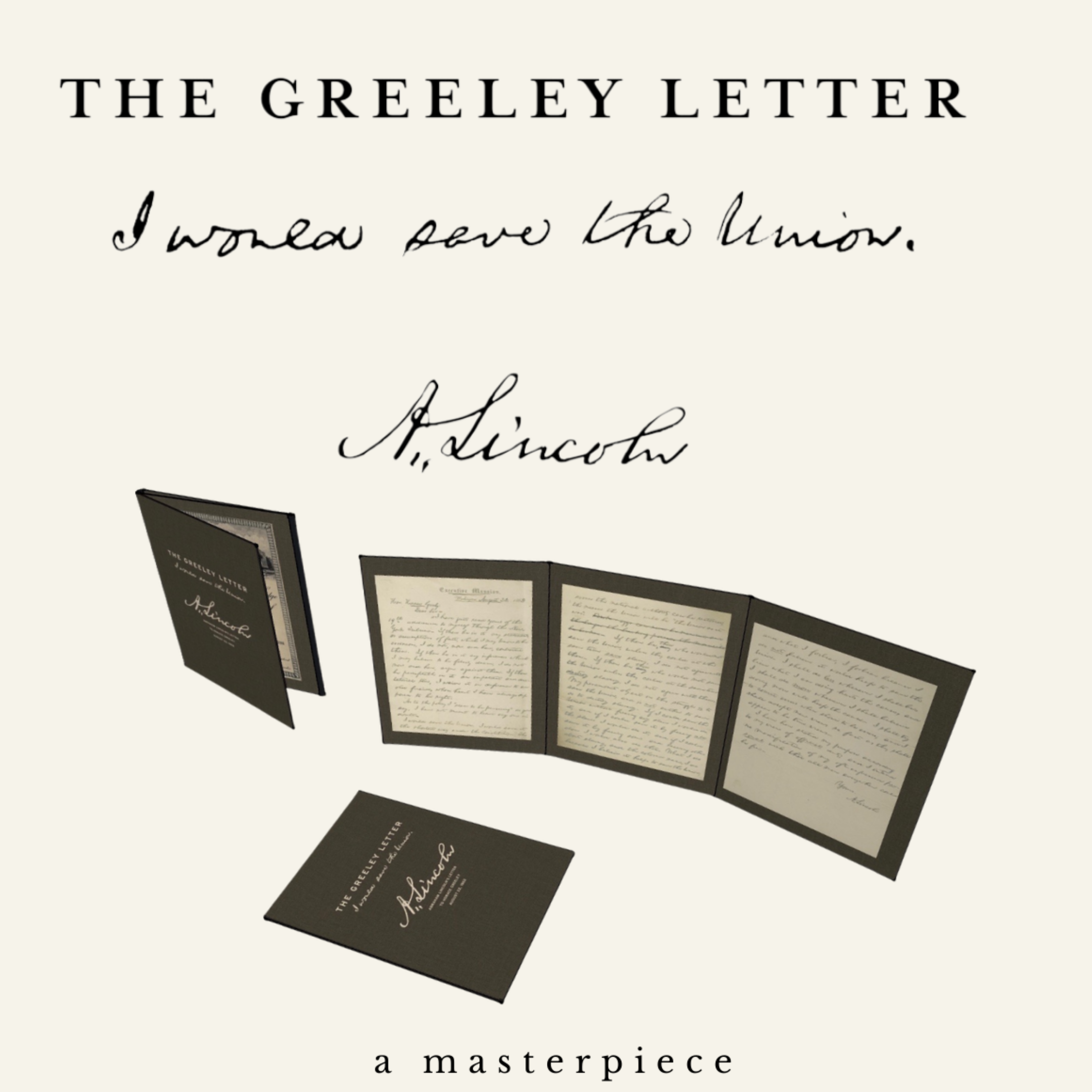
Archival prints of President Lincoln’s original 3-page letter to Horace Greeley written on August 22, 1862.
Abe and me. He wrote the Greeley Letter, August 22, 1862, gave it to my great-grandfather to publish. Today in 2021, I reproduced my great grandfather’s editor copy albumen silver prints of the letter.
THE GREELEY LETTER archival prints beautifully presented within an elegant linen bound tri-folio and embossed cover with words from the letter “I would save the Union” followed by Lincoln’s famous signature.
Archival Prints of the Greeley Letter
Special thanks for the efforts of talented graphic designers, Rumora Studios and team Portfolio Box, Warren, RI for design and production, and for the love, support and encouragement from my family and brother, James C. Welling (yes, another one). A list of print specs and packaging materials are included with each Greeley Letter archival print.
The Greeley Letter, is a masterpiece – an American history treasure. It is inspiring beyond words, three quintessential pages of history.
During my Jan 16, 2021 interview on Untold Civil War podcast we spoke about a couple major events of the Civil War that were witnessed by members of my family.
On August 22, 1862 when President Lincoln finished his famous letter to Horace Greeley he had the letter delivered to and published by National Intelligencer editor, my great grandfather, James Clarke Welling.
Also, another family member, my great great grandmother, Elizabeth L. C. Dixon was a witness at the Petersen House, when President Lincoln died at 7:22 am on April 15, 1865.
Follow Lost and Found History on Instagram for new stories.
On August 22, 1862 President Abraham Lincoln wrote his, now famous, public letter to Mr. Horace Greeley, editor of the New-York Tribune.
Lincoln never sent the letter to Greeley. He sent it to a rival editor, National Intelligencer editor, James Clarke Welling, who published a ‘revised version’ the following day.
President Lincoln’s private secretary, John Nicolay later recollected:
On August 22, 1862 President Lincoln wrote an open letter to Horace Greeley, editor of New York Tribune. This letter, which has become famous in history, he sent to the National Intelligencer for publication. Dr. James Clarke Welling was at that time the editor in charge, and he did what few young editors would have ventured upon. He wanted to make a change to Lincoln’s text so he immediately carried the manuscript back to the President, and suggested its omission. President Lincoln good-naturedly complied, not that he was convinced of the alleged imperfection, but because he never stubbornly resisted advice where only trifles were concerned.
Recollections of John Nicolay Private Secretary to President Lincoln Princeton College Bulletin Volume VII; April, 1895
From an early age, Dr. James Clarke Welling was passionate about historical accuracy. His college thesis at Princeton was Causes of Historical Discrepancies.
In 1880 Dr. James Clarke Welling brought to the attention of the Library of Congress that another revision should be made on the printed version of the text of the published letter to Greeley. Dr. Welling referred to the original letter in his possession and corrected the misprinted word from “this” union to “the” union.
Lincoln, Abraham. Abraham Lincoln papers: Series 2. General Correspondence. 1858 to 1864: Abraham Lincoln to Horace Greeley, Friday, Clipping from Aug. 23, 1862 Daily National Intelligencer, Washington, D.C . 1862. Manuscript/Mixed Material. https://www.loc.gov/item/mal4233400/.
The original manuscript of President Lincoln’s Proclamation, written July 25, 1862 was a prelude to the Emancipation Proclamation.
After President Lincoln composed this proclamation, the draft handwritten copy was delivered to editor, James Clarke Welling, for publication in the National Intelligencer.
As mentioned in a previous post, Lincoln did the same gesture a month later, when he delivers his famous Greeley Letter to Welling who published and then retained the original draft of Greeley Letter throughout his lifetime.
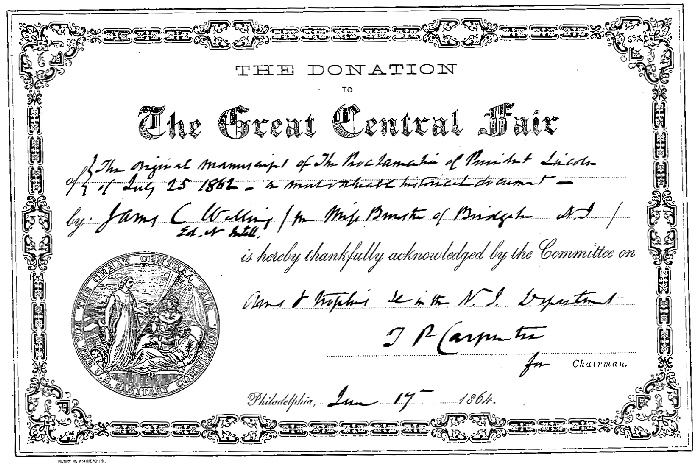
As for the July 25th, 1862 proclamation after he received and published it in the Intelligencer, James C. Welling donated the page torn from history to the New Jersey Committee at the 1864 Great Fair of Philadelphia.
The manuscript was sold by lottery and the lucky bidder was Anne Hampton Brewster, who bequeathed her books, manuscripts and maps to the Library Company of Philadelphia.
Newspaper clippings, relics and photos from our family archives offer clues about their lives and friendships during the Civil War years.
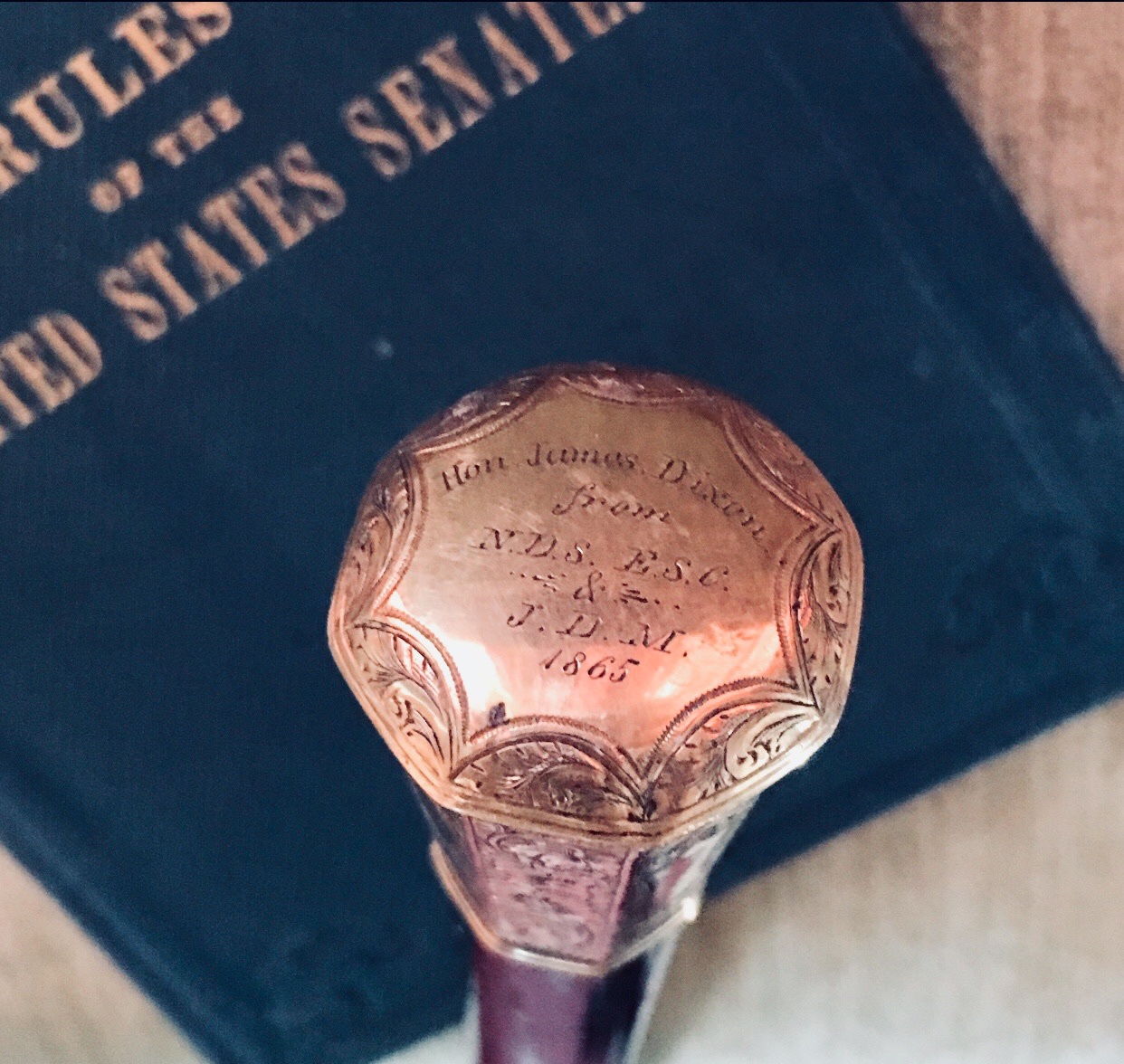
Dixon Cane
Presentation cane
In 1865 this wooden cane was given to Sen. James Dixon. Engraved on the gold handle; Hon. James Dixon from N. D. G. Esq. & J. D. M. 1865.
Dixon was given this cane in 1865, the year the Civil War ended. The gift of a cane, sometimes called a presentation cane, was a gesture of respect, admiration or appreciation.
Who gave the cane to Sen Dixon? All we know are their initials. Who was NDG Esq. and JDM? Can you can identify these mysterious friends? If you can pose a guess, please let us know.
NOTES
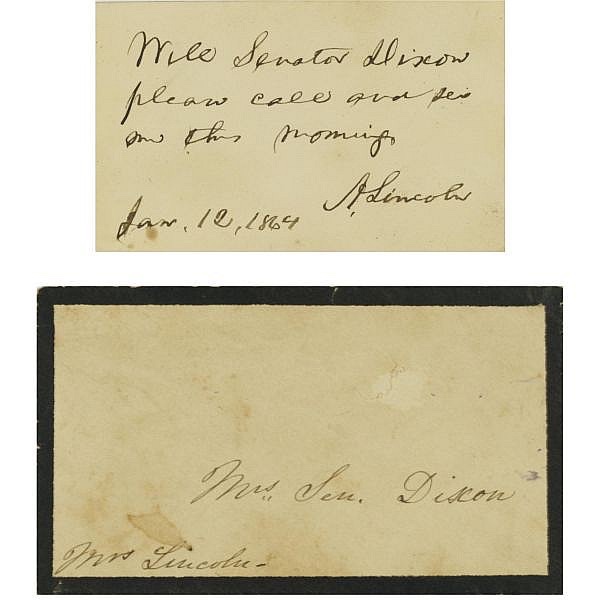
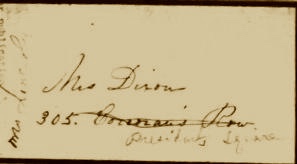
The bottom envelope addressed to Mrs. Dixon written during the Civil War was from Mrs. Lincoln. Note the address was 305 Corcoran’s Row.
President Lincoln crossed that address out and changed the address to Presidents Square.
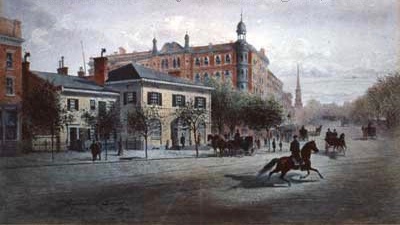
Because revisions to the numbering systems before and after the Civil War, I have had a difficult time confirming where these addresses are in present day Washington, DC. City directories retrace the Dixons back to a home at 28 Presidents Square.
The District of Columbia directory notes in: 1863 Sen. J. Dixon 28 Presidents Square PA Avenue, 1864 Sen. J. Dixon 28 PA Avenue
Turns out this is 28 Presidents Sq. next to Riggs Bank on Penn Ave.
Newspapers:
May 1861
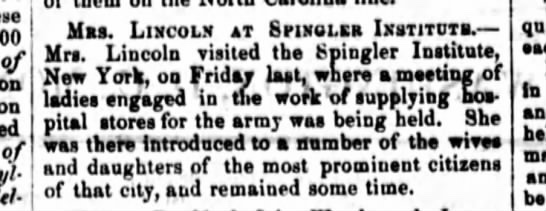
1861 Mary Lincoln visits NYC Spingler Institute for Young Ladies
“Mrs. Lincoln visited tbe Spingler Institute, New York, on Friday last, where a meeting of ladies engaged in the work of supplying hospital stores for the army was being held. She was there introduced to a number of the wives and daughters of the most prominent citizens of that city, and remained some time.”
Coincidentally, the daughter of Elizabeth Dixon attended Spingler Institute, around the corner from Fifth Avenue Hotel.
In a letter to her nephew O. C. Marsh, E. L. Dixon jested about the school as “Spinster Institute”.
Photo album of Elizabeth Dixon:
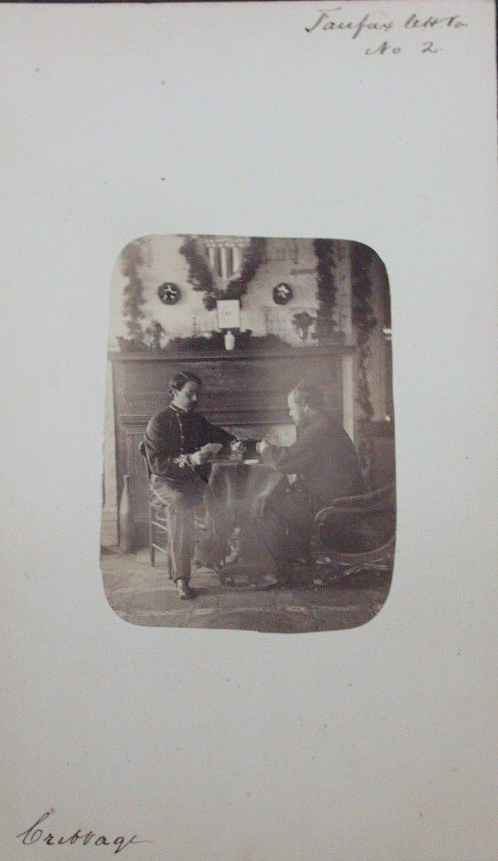
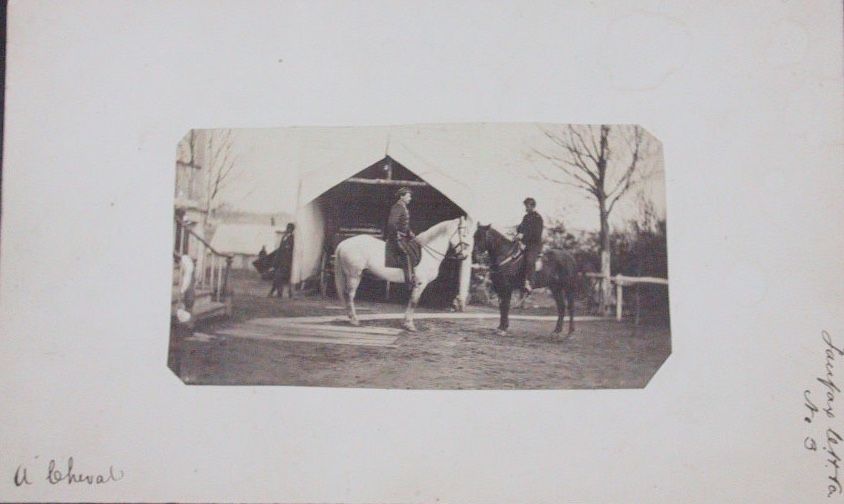
1864 Mar 29 Mrs. Dixon and ladies visit officers and Gen.Tyler in Virginia
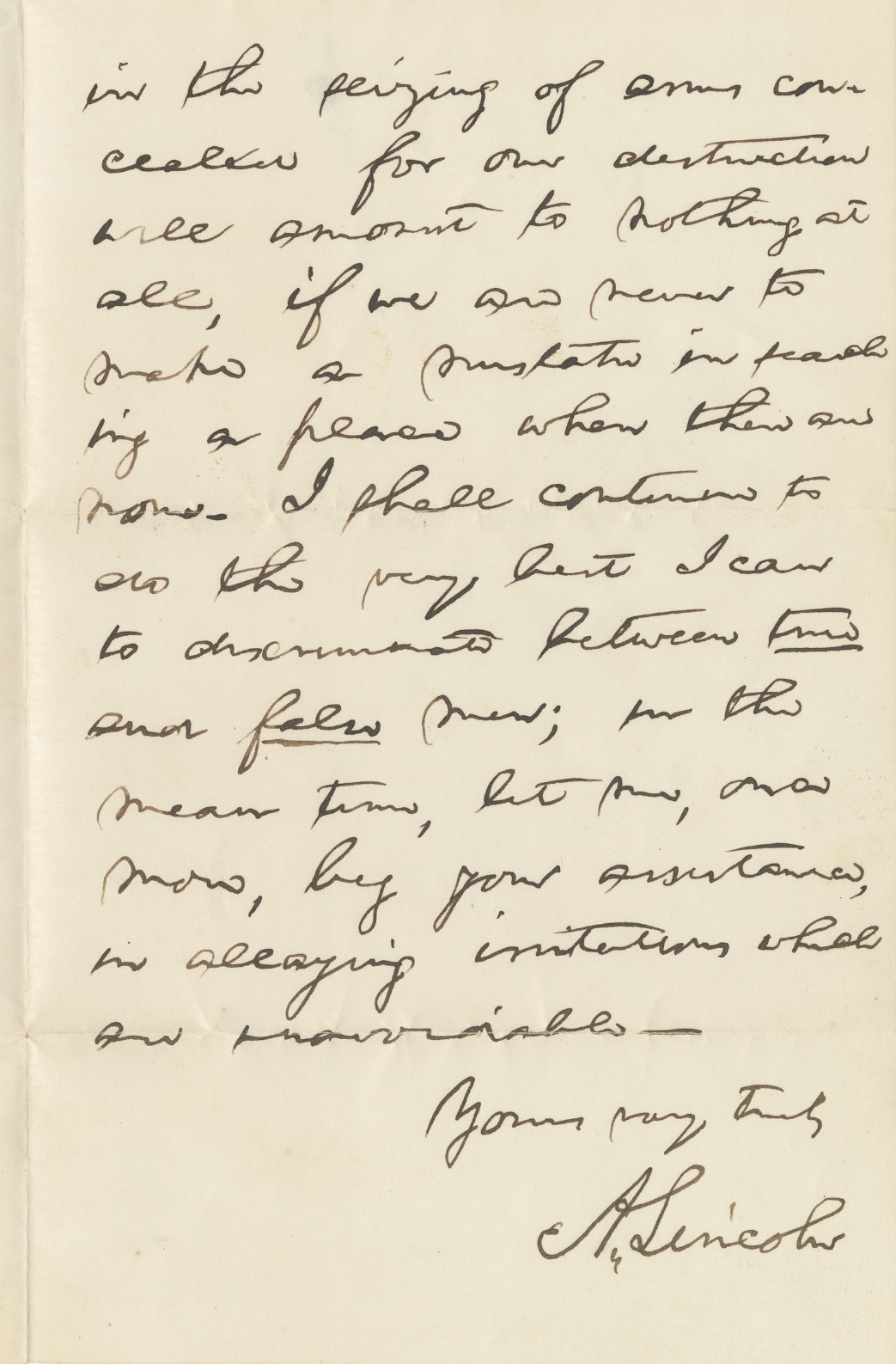
Below is a handwritten letter by President Lincoln dated July 27, 1861. I found it among my family’s papers. It intrigued me. Why did we have it. Why would have Lincoln given this letter to someone in my family?
By 1861 President Lincoln knew my great-great grandfather, Connecticut Senator James Dixon, as well as my great grandfather, Dr. James Clarke Welling, editor of the National Intelligencer newspaper.
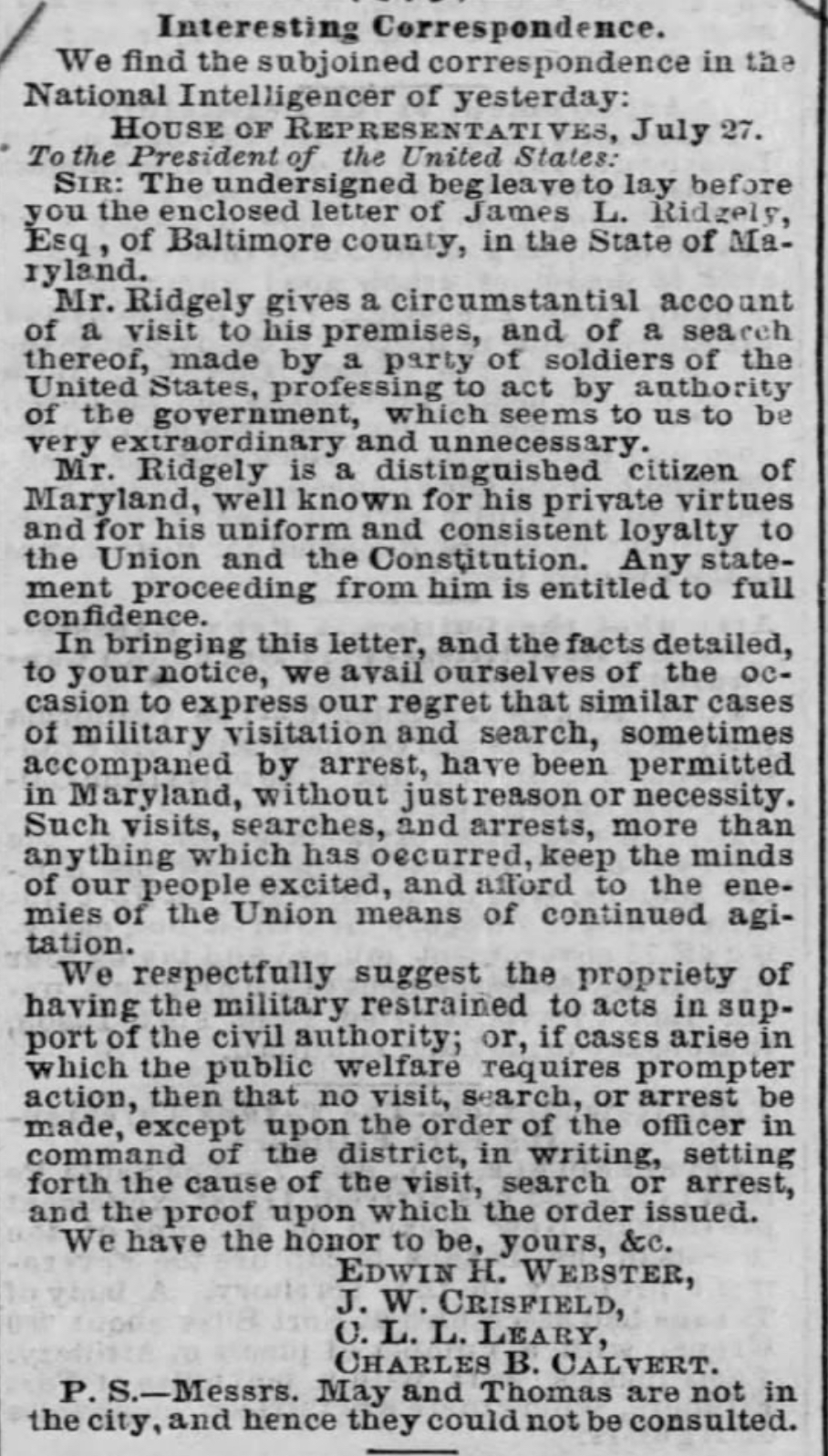
Searching around I foundtext of the letter in a National Intelligencer clipping dated August 6, 1861 and another letter addressed to President Lincoln:
—–
TO PRESIDENT LINCOLN
House of Representatives, July 27.
To the President of the United States: Sir: The undersigned beg leave to lay before you the enclosed letter of James L. Ridgley, Esq , of Baltimore county, in the State of Maryland. Mr. Ridgely gave a circumstantial account of a visit to his premises, and of a search thereof, made by a party of soldiers of the United States, professing to act by authority of tbe government, which seems to us to be very extraordinary and unnecessary. Mr. Ridgely is a distinguished citizen of Maryland, well known for his private virtues and for his uniform and consistent loyalty to the Union and the Constitution. Any statement proceeding from him is entitled to full confidence. In bringing this letter, and the facts detailed, to your notice, we avail ourselves of the occasion to express our regret that similar cases of military visitation and search, sometimes accompaned by arrest, have been permitted in Maryland, without just reason or necessity. Such visits, searches, and arrests, more than anything which has occurred, keep the minds of our people excited, and afford to the enemies of the Union means of continued agitation. We respectfully suggest the propriety of having the military restrained to acts in support of the civil authority; or, if cases arise in which the public welfare requires prompter action, then that no visit, search, or arrest be made, except upon the order of the officer in command of the district, in writing, setting forth the cause of the visit, search or arrest, and the proof upon which the order issued. We have the honor to be, yours,
Edwin H. Webster, J. W. Crisfield, C. L. L. Leary, Charles B. Calvert.
P. S. Messrs. May and Thomas are not in the city, and hence they could not be consulted
President Lincoln responded to their letter with the letter I discovered in our family papers:
National Intelligencer 1861 clipping
To this letter the President of the United States replied as follows
Executive Mansion, July 27, 1861
Hon. Edwin H. Webster, J. W. Crisfield, C. L. L. Leary, and Charles B. Calvert.
Gentlemen: Yours of to-day, with the enclosure from Mr. Ridgely, has been received and referred to Gen. Scott, as I knew nothing whatever of the particular case. May I beg you to consider the difficulties of my position and solicit your kind assistance in it. Our security in the seizing of arms for our destruction will amount to nothing at all if we are never to make mistakes in searching a place where there are none. I shall continue to do the very best I can to discriminate between true and false men. In the meantime, let me once more beg your assistance in allaying irritations which are unavoidable. Yours, very truly, A. Lincoln.
—
It was in answer to the representations made by Messrs. Webster, Crisfield, Leary and Calvert, and in conformity with the suggestions they had made, that the following army order was issued by Gen. Scott, and with which our readers are already familiar:
Headquarters of the Army, Washington, July 30, 1861. General Orders, No. 12.
Searches of houses for aims, traitors or spies, and arrests of offenders in such matters, shall only be made in any department by the special authority of the commander thereof, except in extreme cases admitting of no delay. By command of Lieut. Gen. Scott: E. D. Townsend, Assistant Adjutant General
What does History say about the letter?
Collected Works of Abraham Lincoln Vol 1, Basler notes:
No trace of the original manuscript has been found, but the contents of the letter suggest that it may have been written at the time of the Baltimore arrests. The fact that Lincoln answers on the same date the incoming letter was written, suggests that his correspondents were not farther away than Baltimore.
Mystery solved:
President Lincoln gave the letter to Dr. James C. Welling, managing editor of the National Intelligencer newspaper.
Dr. Welling published the letter in the National Intelligencer on 06 Aug 1861.
Dr. Welling, died in 1894 and his daughter died in 1976, they kept it during their lives until I discovered it.
Wonder if anyone wants to know where it is? Lincoln historians?
Great- granddaughter of National Intelligencer editor, Dr. James Clarke Welling will be waiting. It’s safe in a public archive. Details info simply contact me.
President Lincoln returns to White House about 7 P.M. and learns from Sec. Seward that battle has been lost. Remains awake all night, listening to stories of senators and congressmen returning from battlefield. The editor of the National Intelligencer, who went out on Sunday as one of the volunteer nurses says the battle, it is said, was planned and commanded on our part, for the greater portion of the time by General Siegel, who gave orders to our forces to hold their position and await attack by the enemy, supposed to be Jackson. Instead of this McDowell, who holds the extreme left, advanced in attacked Longstreet’s division on the enemies right. He was met by a terrible thro from the rebels, during which General Slocum’s brigade was terribly cut up and McDowell was forced to give way. He was reinforced by a portion of Fitz John Porter’s division, and any attack was made on the assailants, when they were in turn driven back to their original positions.
For a glimpse back in time and estate of the family of Sen. James Dixon in Hartford head to Hartford, Connecticut, and head west from the downtown area.
On the left side of Farmington Avenue, in what is now historical neighborhood of Asylum Hill, you will see the site where once stood Rose-Mount, the estate of Senator James Dixon, his wife, Elizabeth Lord Cogswell and their children.
The Dixons purchased the tract of 14 acres of land in 1840 and built was a large mansion, several small out-buildings and a barn. Their beautiful gardens, inspired them to name their home: Rose-Mount. Mrs. Sigourney wrote in of the the Dixon’s wonderful home;
“Many of the residences on Asylum Hill are conspicuous for their elegance and grace. Among these, Rose-Mount, the seat of James Dixon, Esq., is particularly distinguished by the.extent and arrangement of its grounds. Fourteen acres, highly cultivated, are divided into lawns, gardens, and groves, and embellished with parterres of flowers, hedges, and a variety of shrubs, fruits, and forest-trees. All is found here to constitute a delightful retirement for the man of letters and of taste, where cultivated intellect may enjoy the luxuries of literature, or woo the willing muse.” Scenes In My Native Land [1]
Paradise Lost The Dixon–Welling Place
Over the years, Rose-Mount became known as the Dixon–Welling Place, daughter Clementine married James C. Welling, editor of Washington, D.C newspaper National Intelligencer and was host to many of our nation’s most celebrated writers, poets, dignitaries and military leaders of the day. For more than 70 years the Dixon and Welling family lived here until 1929 when they sold the 12 acre property to the Aetna Insurance Company.
Today, the only remnants of this paradise lost are several copper beach trees on the grounds and the Dixon’s large bell that hung outside the main house to summon the gardeners.
Imagine you discovered Civil War relics that confirmed someone in your family witnessed the death of President Lincoln. This is precisely what happened to me.
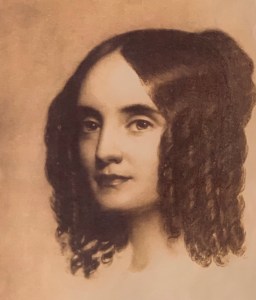
Found within our family collection of Civil War relics are artifacts left our great-great-grandmother, Elizabeth L. C. Dixon that confirmed she witnessed that fateful night and details of her close friendship with the Lincoln’s – from their first days in Washington, until their last.
The writing and relics left by Elizabeth L. C. Dixon, preserved over generations, offer an intimate glimpse into the past, from a new vantage point.
So, ‘Why was her friendship with the Lincoln’s overlooked in history?’ and ‘Why am I the first of her children to share this trove of Civil War treasures publicly? The answers to these questions may surprise you.
Over the last decade, after discovering dozens and dozens of Civil War relics, papers, diaries, photographs in our family’s basements, attics and historical societies it has become clear that our family has needed these 150 years to heal — Elizabeth L. Dixon must have been an archetype for the following generations and we have had to wait until her children’s children’s children were grown that her relics would be found and details of her friendship with the Lincolns finally shared, publicly.
White House History looks at the era of the Mexican-American War in Washington through a complete transcription of the diary of Elizabeth Dixon, wife of Congressman James Dixon.
The first of Elizabeth Dixon’s writings; ‘The Diary of Elizabeth Dixon’, 1845-47′ was featured in ‘White House History’, Issue 33, published by the White House Historical Association.
















 LOST + FOUND HISTORY