
Below is a handwritten letter by President Lincoln dated July 27, 1861. I found it among my family’s papers. It intrigued me. Why did we have it. Why would have Lincoln given this letter to someone in my family?
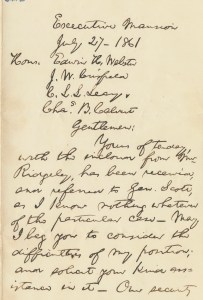
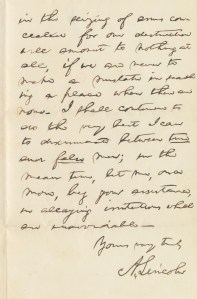
By 1861 President Lincoln knew my great-great grandfather, Connecticut Senator James Dixon, as well as my great grandfather, Dr. James Clarke Welling, editor of the National Intelligencer newspaper.
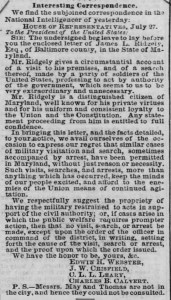
Searching around I found text of the letter in a National Intelligencer clipping dated August 6, 1861 and another letter addressed to President Lincoln:
—–
TO PRESIDENT LINCOLN
House of Representatives, July 27.
To the President of the United States: Sir: The undersigned beg leave to lay before you the enclosed letter of James L. Ridgley, Esq , of Baltimore county, in the State of Maryland. Mr. Ridgely gave a circumstantial account of a visit to his premises, and of a search thereof, made by a party of soldiers of the United States, professing to act by authority of tbe government, which seems to us to be very extraordinary and unnecessary. Mr. Ridgely is a distinguished citizen of Maryland, well known for his private virtues and for his uniform and consistent loyalty to the Union and the Constitution. Any statement proceeding from him is entitled to full confidence. In bringing this letter, and the facts detailed, to your notice, we avail ourselves of the occasion to express our regret that similar cases of military visitation and search, sometimes accompaned by arrest, have been permitted in Maryland, without just reason or necessity. Such visits, searches, and arrests, more than anything which has occurred, keep the minds of our people excited, and afford to the enemies of the Union means of continued agitation. We respectfully suggest the propriety of having the military restrained to acts in support of the civil authority; or, if cases arise in which the public welfare requires prompter action, then that no visit, search, or arrest be made, except upon the order of the officer in command of the district, in writing, setting forth the cause of the visit, search or arrest, and the proof upon which the order issued. We have the honor to be, yours,
Edwin H. Webster, J. W. Crisfield, C. L. L. Leary, Charles B. Calvert.
P. S. Messrs. May and Thomas are not in the city, and hence they could not be consulted
President Lincoln responded to their letter with the letter I discovered in our family papers:

To this letter the President of the United States replied as follows
Executive Mansion, July 27, 1861
Hon. Edwin H. Webster, J. W. Crisfield, C. L. L. Leary, and Charles B. Calvert.
Gentlemen: Yours of to-day, with the enclosure from Mr. Ridgely, has been received and referred to Gen. Scott, as I knew nothing whatever of the particular case. May I beg you to consider the difficulties of my position and solicit your kind assistance in it. Our security in the seizing of arms for our destruction will amount to nothing at all if we are never to make mistakes in searching a place where there are none. I shall continue to do the very best I can to discriminate between true and false men. In the meantime, let me once more beg your assistance in allaying irritations which are unavoidable. Yours, very truly, A. Lincoln.
—
Headquarters of the Army, Washington, July 30, 1861. General Orders, No. 12.
Searches of houses for aims, traitors or spies, and arrests of offenders in such matters, shall only be made in any department by the special authority of the commander thereof, except in extreme cases admitting of no delay. By command of Lieut. Gen. Scott: E. D. Townsend, Assistant Adjutant General
What does History say about the letter?
Collected Works of Abraham Lincoln Vol 1, Basler notes:
No trace of the original manuscript has been found, but the contents of the letter suggest that it may have been written at the time of the Baltimore arrests. The fact that Lincoln answers on the same date the incoming letter was written, suggests that his correspondents were not farther away than Baltimore.
Mystery solved:
Dr. Welling, died in 1894 and his daughter died in 1976, they kept it during their lives until I discovered it.
Wonder if anyone wants to know where it is? Lincoln historians?
Great- granddaughter of National Intelligencer editor, Dr. James Clarke Welling will be waiting. It’s safe in a public archive. Details info simply contact me.
 LOST + FOUND HISTORY