The Famous Greeley Letter

THE GREELEY LETTER is a masterpiece

Of the millions of pages of history written about the Civil War, my focus lately has been a three page letter written in Lincoln’s handwriting. It is the famous letter President Lincoln wrote on August 22, 1862 to Horace Greeley, editor of the New-York Tribune. Words from this letter are etched in history:

My paramount object in this struggle is to save the Union and is not either to save or to destroy slavery.

Lincoln historian, Phillip Shaw Paludan wrote in The Presidency of Abraham Lincoln:

If there is one document that is more often quoted than any other in the argument, debate, or conversation about Lincoln — it is the letter that Lincoln wrote on August 22, 1862 to Horace Greeley.  

President Lincoln seated on left, Horace Greeley on right, words read; On Friday, August 22nd, 1862, President Abraham Lincoln wrote his famous letter to NY Tribune editor, Horace Greeley

It was on Friday, August 22nd, 1862 President Abraham Lincoln finished writing his now famous letter to Horace Greeley, editor of the New-York Tribune.
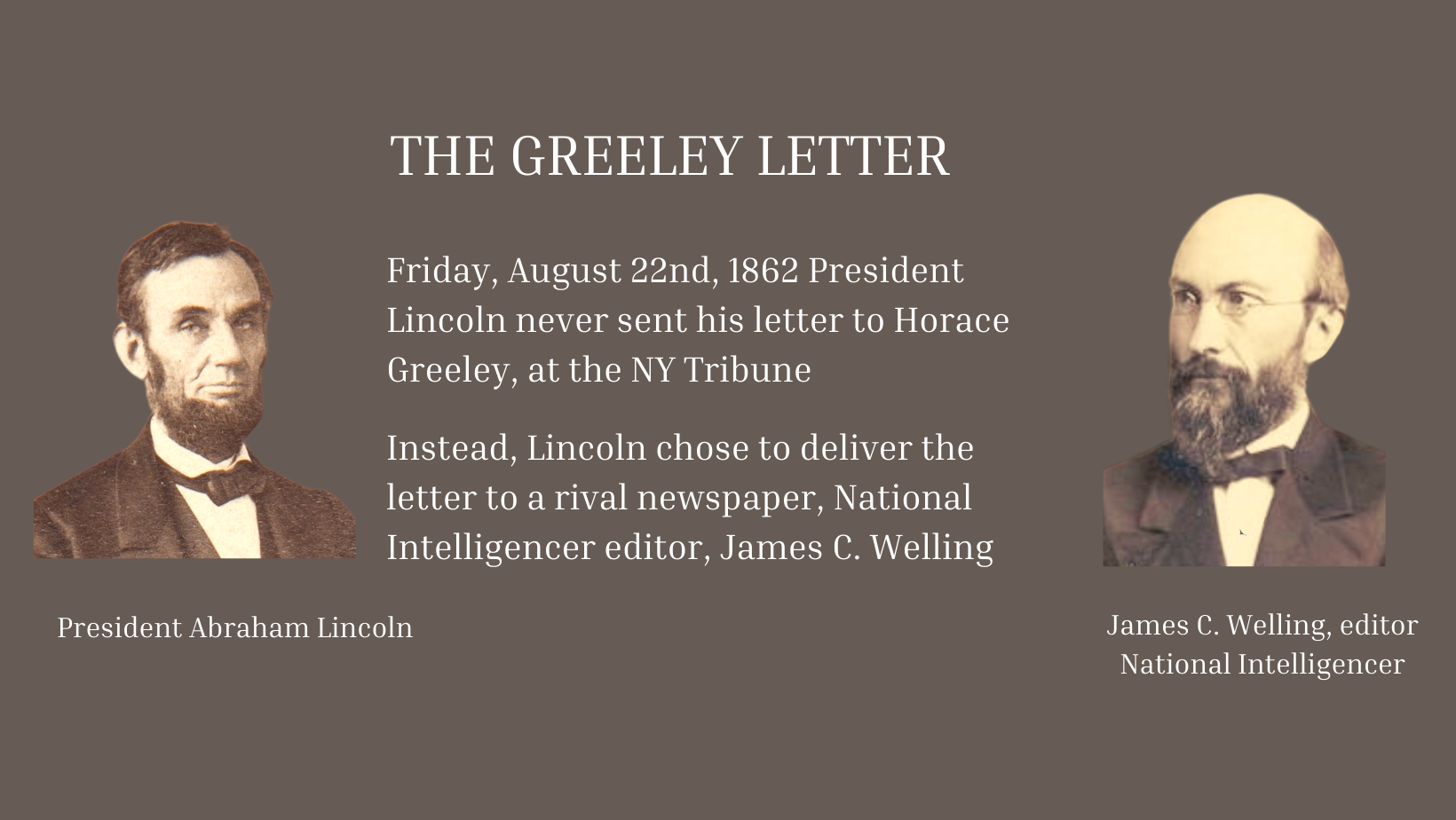
President Lincoln headshot left, James C. Welling headshot right, printed are words: THE GREELEY LETTER  Friday, August 22nd, 1862 President President Lincoln never sent his letter to Horace Greeley, at N-Y Tribune. Instead,  Lincoln chose to deliver the letter to rival newspaper, National Intelligencer editor,  James C. Welling

President Lincoln decided not to send the letter to Greeley. Instead, he had the letter delivered to James C. Welling, editor of the National Intelligencer, a rival newspaper to publish the following day.

Looking at the original letter, you see that one sentence has a line through it, as though Lincoln changed his mind and crossed the words out.
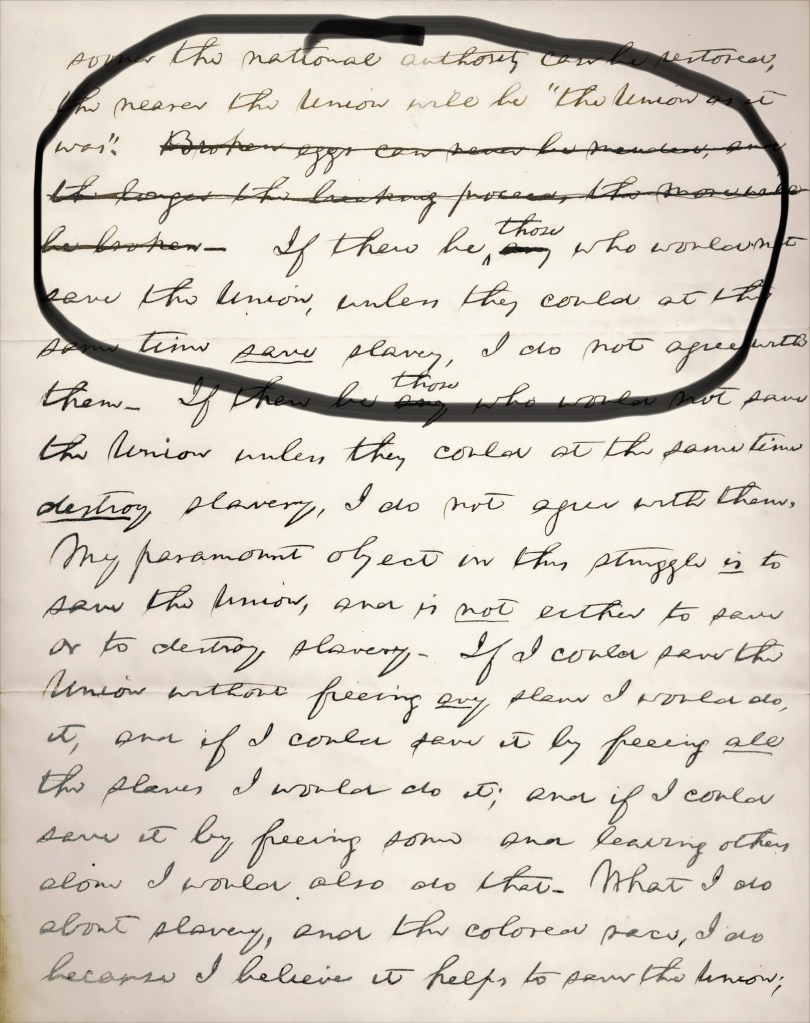
The original second page of Aug 22,1862 letter from Lincoln to Greeley noting the revision of sentence omitted in Aug 23, 1862 National Intelligencer published version .
The Greeley Letter, page 2 of 3, revision approved by Lincoln, requested by James C. Welling, editor, National Intelligencer
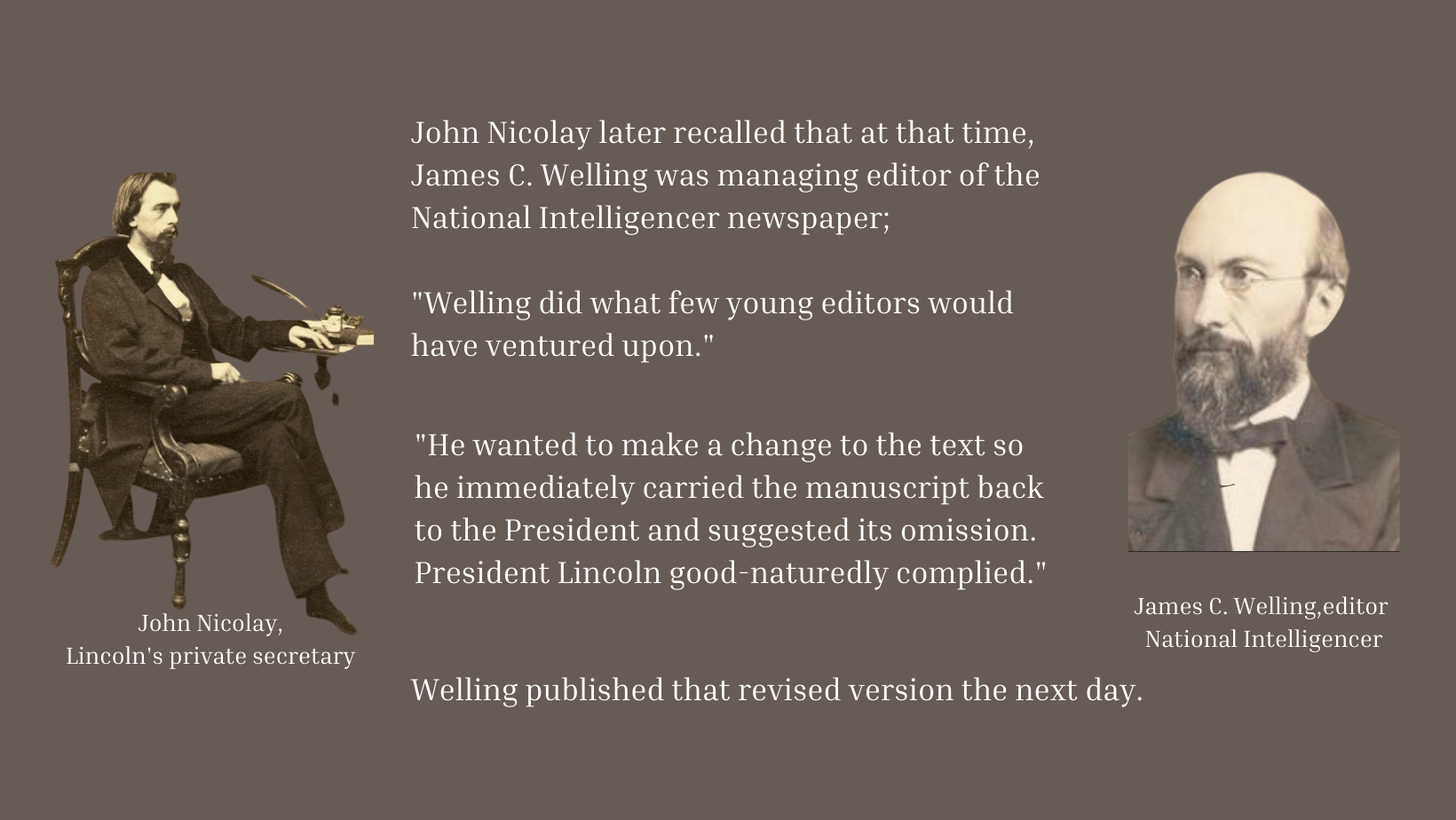
John Nicolay recalled James C. Welling asked Lincoln to revise the Greeley letter

President Lincoln’s secretary, John Nicolay shared the backstory about this revision in Princeton College Bulletin, 1895:

On August 22, 1862, the associate editor of the National Intelligencer, James Clarke Welling did what few young editors would have ventured upon. 

He wanted to make a change to Lincoln’s text so he immediately carried the manuscript back to the President and suggested its omission. President Lincoln good-naturedly complied.
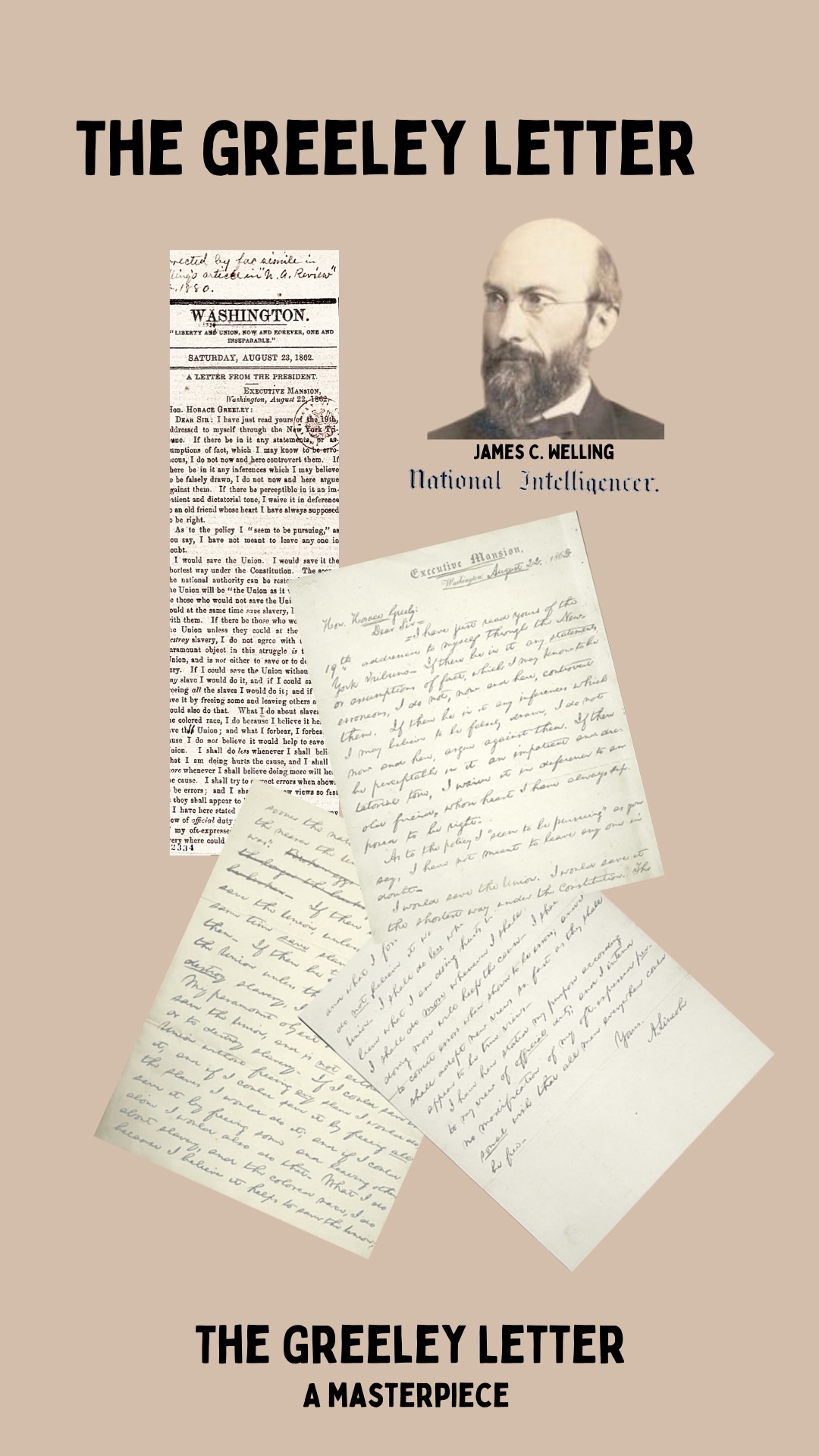
Headshop of James C. Welling on left, on right is LOC August 23, 1862 clipping from National Intelligencer titled; A LETTER FROM THE PRESIDENT; editor James C. Welling published and revised text of Lincoln's letter to NY Tribune editor, Horace Greeley 
Below is the original handwritten letter by Lincoln, Aug 22, 1862, yet revised and published by James C. Welling. The Greeley Letter a masterpiece.
The original letter written by Lincoln, yet revised and published by Welling is a masterpiece.

On Saturday August 23, 1862, Horace Greeley read the famous Greeley Letter, a reply to his editorial, Prayer of Twenty Millions, in a letter addressed to him from President Lincoln within the pages of another newspaper, the National Intelligencer.

The Greeley Letter, I believe, is a masterpiece – an American history treasure. It is inspiring beyond words, three quintessential pages of history.

I’m not alone. My great grandfather, James C. Welling, to whom Lincoln gave the letter, certainly believed it was an American treasure. He kept the Greeley letter his entire life.
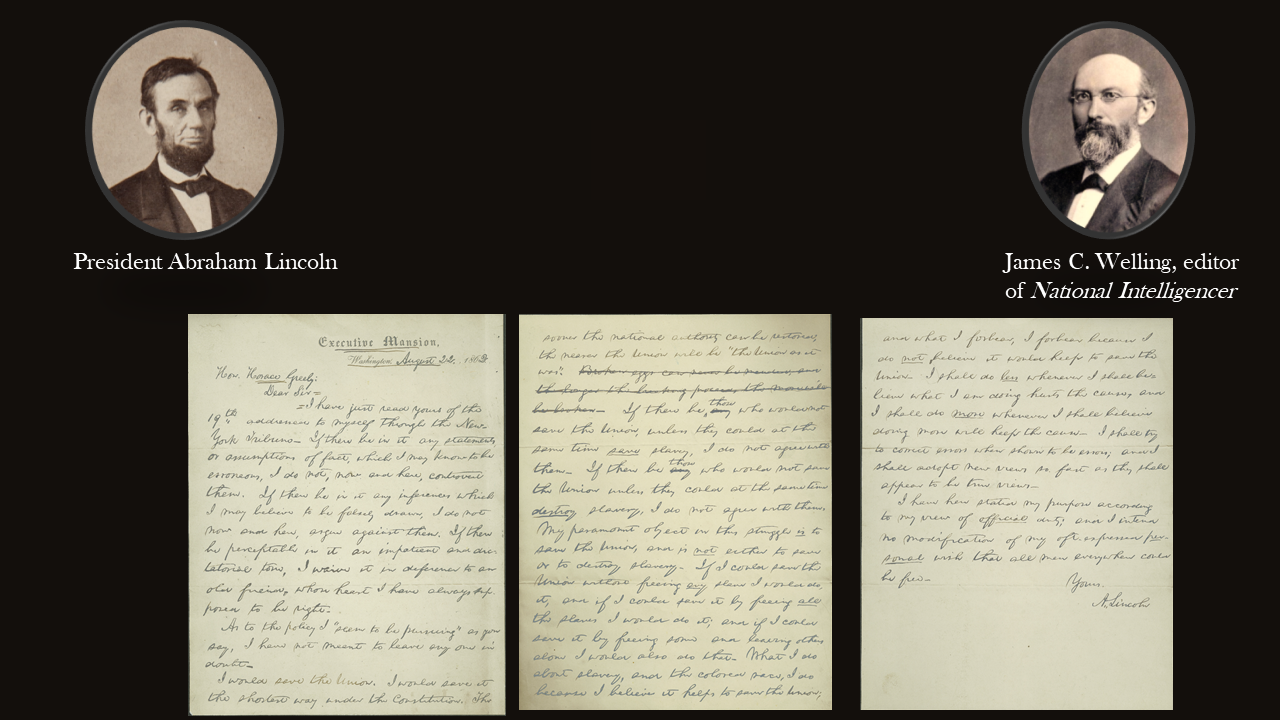
President Lincoln and James Clarke Welling headshots and below is Lincoln's 3 page letter given to and published by Welling, his great granddaughter, Caroline Welling Van Deusen has made archival prints
Lincoln and James C. Welling above Lincoln’s letter to Horace Greeley given to Welling.

And after his death our family fulfilled his wishes to find a permanent home for the famous Greeley Letter. We chose not to sell it to a private collector but place the masterpiece where the greatest number of people would see it, and accessible to the public, in perpetuity. What better place for the Greeley Letter, our masterpiece, than the oldest public art museum in the country, the Wadsworth Atheneum.

Knowing the Greeley Letter is safely preserved, within a safe, in a vault at the Wadsworth Athenaeum, I continue with our family’s wish—- that the greatest number of people could see the masterpiece, so that’s why I began an initiative during the Covid pandemic to create Archival Prints of the famous Greeley Letter.

Today, I am proud to announce my 2021 launch of my website: TheGreeleyLetter.com and a limited series of archival prints for sale. I personally printed, packaged and will ship Greeley Letter prints to you.

THE GREELEY LETTER

Archival prints of President Lincoln’s original 3-page letter to Horace Greeley written on August 22, 1862.
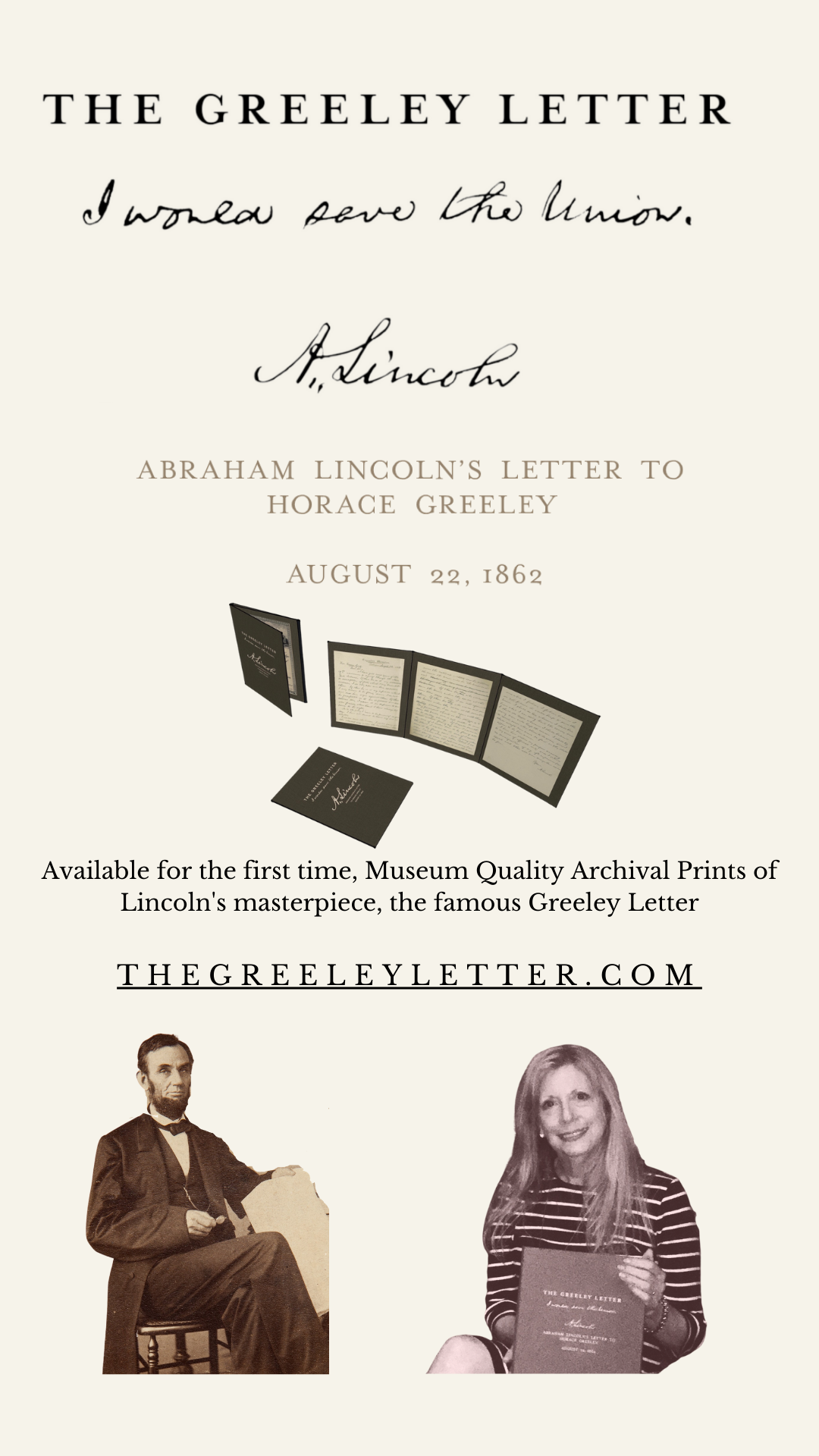
The Greeley Letter,  is a masterpiece – an American history treasure. It is inspiring beyond words, three quintessential pages of history.
Abe and me. He wrote the Greeley Letter, August 22, 1862, gave it to my great-grandfather to publish. Today in 2021, I reproduced my great grandfather’s editor copy albumen silver prints of the letter.

THE GREELEY LETTER archival prints beautifully presented within an elegant linen bound tri-folio and embossed cover with words from the letter “I would save the Union” followed by Lincoln’s famous signature.
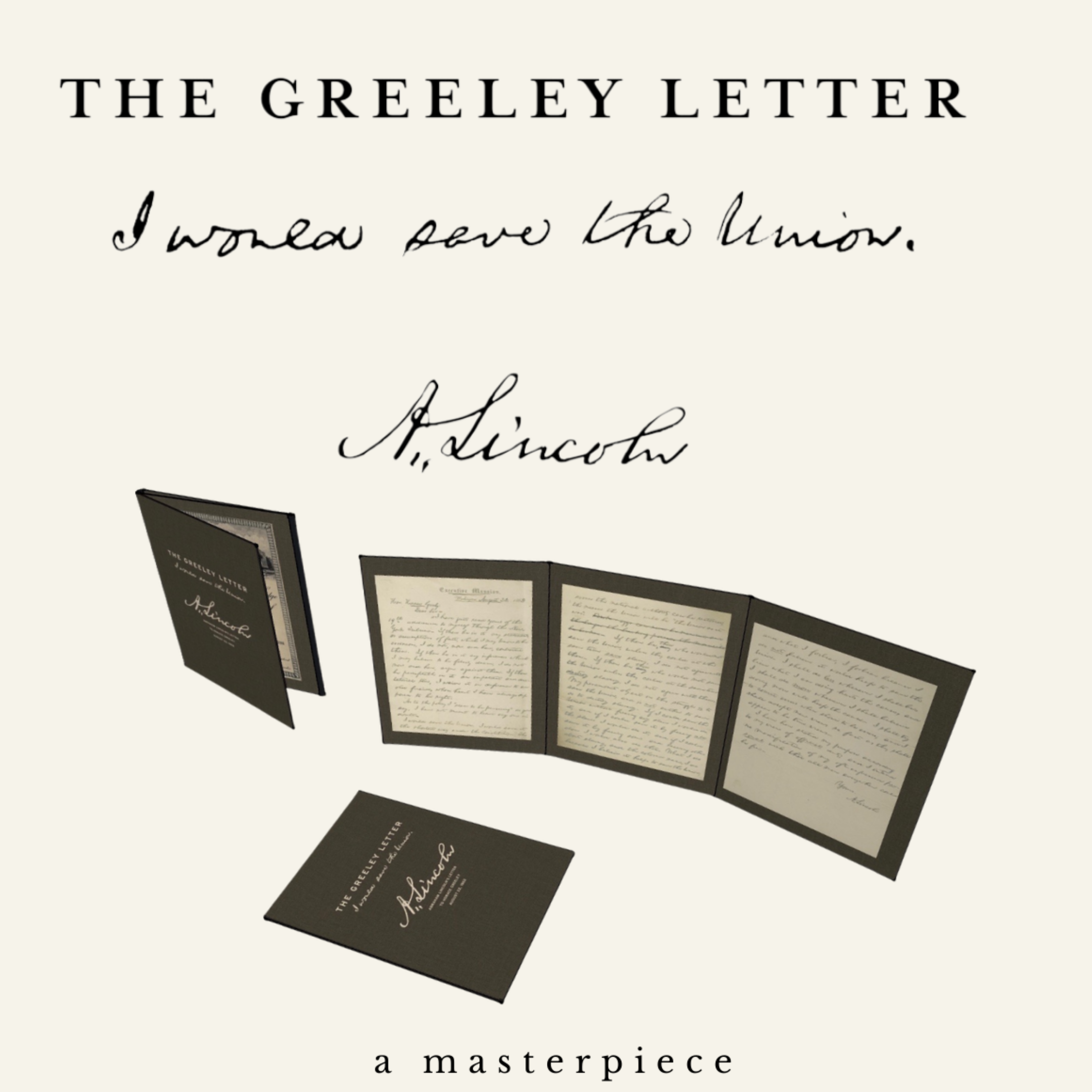
Archival Prints of the Greeley Letter

Special thanks for the efforts of talented graphic designers, Rumora Studios and team Portfolio Box, Warren, RI for design and production, and for the love, support and encouragement from my family and brother, James C. Welling (yes, another one). A list of print specs and packaging materials are included with each Greeley Letter archival print.

The Greeley Letter, is a masterpiece – an American history treasure. It is inspiring beyond words, three quintessential pages of history.

To order go to: http://thegreeleyletter.com

Lost Lincoln Letter

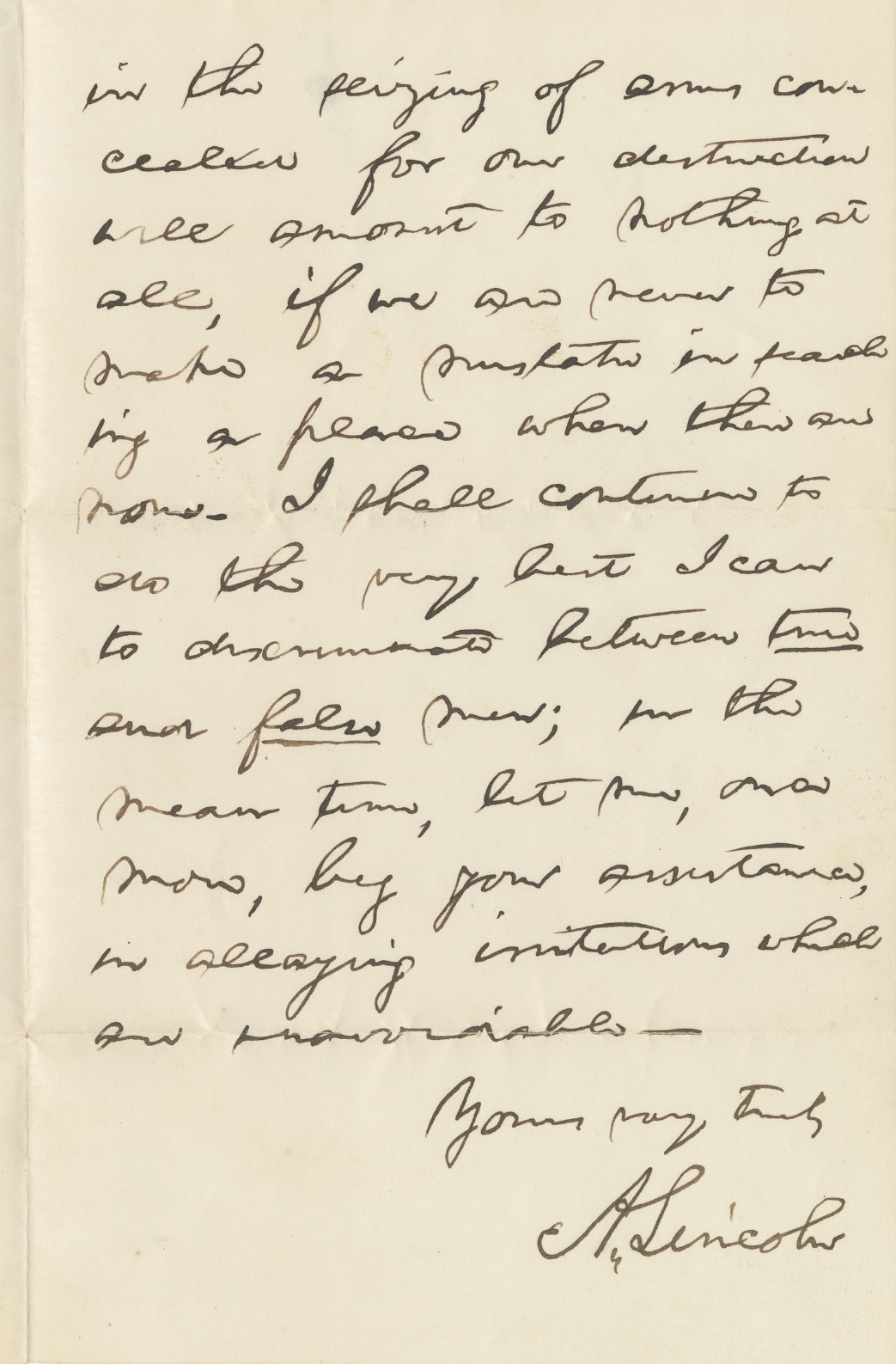
Below is a handwritten letter by President Lincoln dated July 27, 1861. I found it among my family’s papers. It intrigued me. Why did we have it. Why would have Lincoln given this letter to someone in my family?

By 1861 President Lincoln knew my great-great grandfather, Connecticut Senator James Dixon, as well as my great grandfather, Dr. James Clarke Welling, editor of the National Intelligencer newspaper.

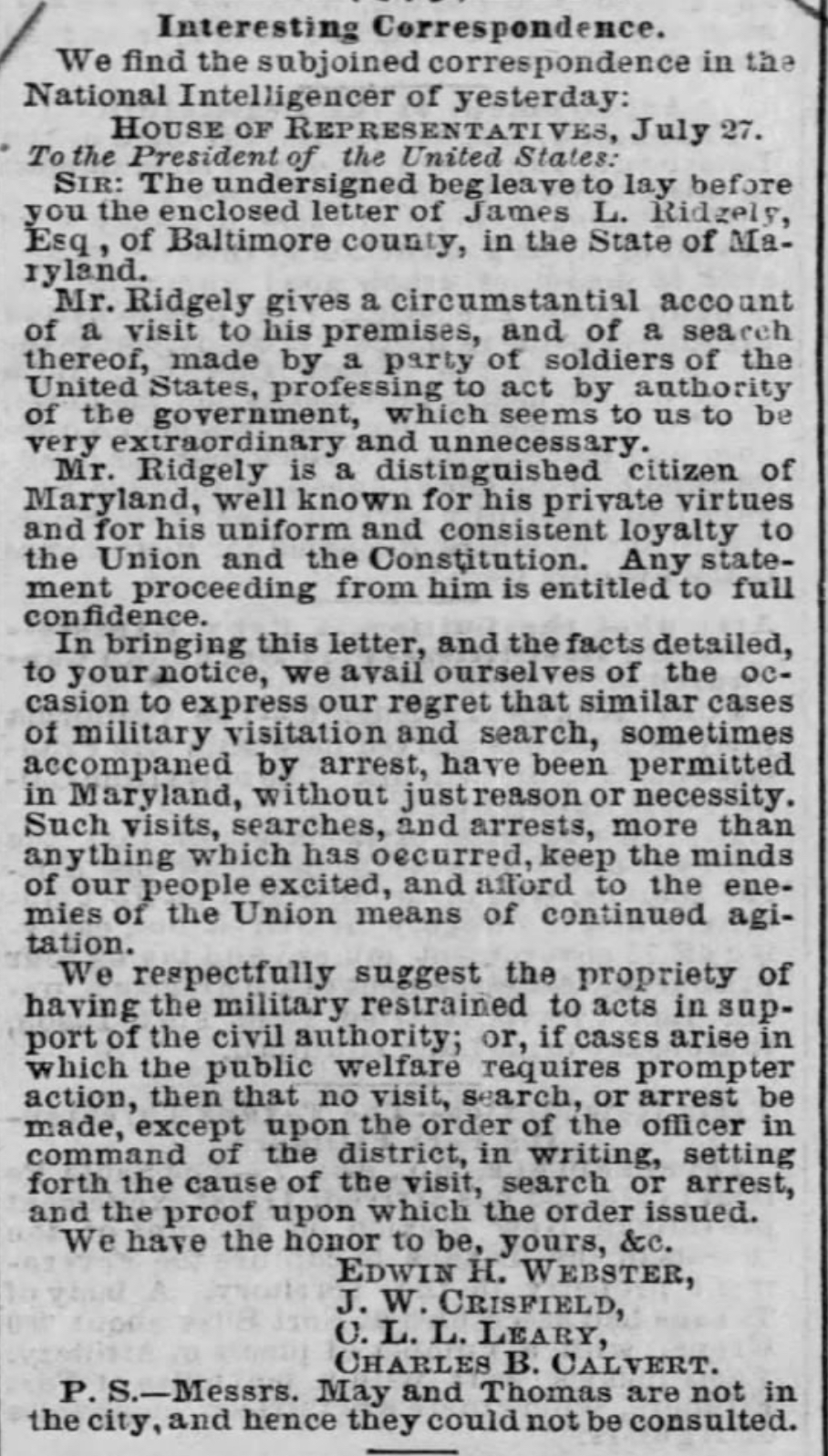
Searching around I found text of the letter in a National Intelligencer clipping dated August 6, 1861 and another letter addressed to President Lincoln:

—–

TO PRESIDENT LINCOLN

House of Representatives, July 27. 

To the President of the United States:  Sir: The undersigned beg leave to lay before you the enclosed letter of James L. Ridgley, Esq , of Baltimore county, in the State of Maryland. Mr. Ridgely gave a circumstantial account of a visit to his premises, and of a search thereof, made by a party of soldiers of the United States, professing to act by authority of tbe government, which seems to us to be very extraordinary and unnecessary. Mr. Ridgely is a distinguished citizen of Maryland, well known for his private virtues and for his uniform and consistent loyalty to the Union and the Constitution. Any statement proceeding from him is entitled to full confidence. In bringing this letter, and the facts detailed, to your notice, we avail ourselves of the occasion to express our regret that similar cases of military visitation and search, sometimes accompaned by arrest, have been permitted in Maryland, without just reason or necessity. Such visits, searches, and arrests, more than anything which has occurred, keep the minds of our people excited, and afford to the enemies of the Union means of continued agitation. We respectfully suggest the propriety of having the military restrained to acts in support of the civil authority; or, if cases arise in which the public welfare requires prompter action, then that no visit, search, or arrest be made, except upon the order of the officer in command of the district, in writing, setting forth the cause of the visit, search or arrest, and the proof upon which the order issued.  We have the honor to be, yours, 

Edwin H. Webster, J. W. Crisfield, C. L. L. Leary, Charles B. Calvert. 

P. S. Messrs. May and Thomas are not in the city, and hence they could not be consulted

President Lincoln responded to their letter with the letter I discovered in our family papers:

1861-Jul-27-NI-Lincoln-Reply-ToMD-Reps
National Intelligencer 1861 clipping

To this letter the President of the United States replied as follows

Executive Mansion, July 27, 1861

Hon. Edwin H. Webster, J. W. Crisfield, C. L. L. Leary, and Charles B. Calvert.

Gentlemen: Yours of to-day, with the enclosure from Mr. Ridgely, has been received and referred to Gen. Scott, as I knew nothing whatever of the particular case. May I beg you to consider the difficulties of my position and solicit your kind assistance in it. Our security in the seizing of arms for our destruction will amount to nothing at all if we are never to make mistakes in searching a place where there are none. I shall continue to do the very best I can to discriminate between true and false men. In the meantime, let me once more beg your assistance in allaying irritations which are unavoidable. Yours, very truly, A. Lincoln. 

It was in answer to the representations made by Messrs. Webster, Crisfield, Leary and Calvert, and in conformity with the suggestions they had made, that the following army order was issued by Gen. Scott, and with which our readers are already familiar:  

Headquarters of the Army, Washington, July 30, 1861. General Orders, No. 12. 

Searches of houses for aims, traitors or spies, and arrests of offenders in such matters, shall only be made in any department by the special authority of the commander thereof, except in extreme cases admitting of no delay. By command of Lieut. Gen. Scott:  E. D. Townsend, Assistant Adjutant General

What does History say about the letter?

Collected Works of Abraham Lincoln Vol 1, Basler notes:

No trace of the original manuscript has been found, but the contents of the letter suggest that it may have been written at the time of the Baltimore arrests. The fact that Lincoln answers on the same date the incoming letter was written, suggests that his correspondents were not farther away than Baltimore.

Mystery solved:

President Lincoln gave the letter to Dr. James C. Welling, managing editor of the National Intelligencer newspaper.
Dr. Welling published the letter in the National Intelligencer on 06 Aug 1861.

Dr. Welling, died in 1894 and his daughter died in 1976, they kept it during their lives until I discovered it.

Wonder if anyone wants to know where it is? Lincoln historians?

Great- granddaughter of National Intelligencer editor, Dr. James Clarke Welling will be waiting. It’s safe in a public archive. Details info simply contact me.